Introduction: The New Era of Cloud Communication in Healthcare
Healthcare is undergoing a transformation driven by the need for timely, secure, and patient-focused communication. Traditional channels—telephone, fax, and fragmented messaging—have long impeded the flow of information between patients, clinicians, and administrative teams. Cloud communication in healthcare has emerged as a pivotal solution, unifying voice, video, SMS, and data-driven messaging into seamless, scalable platforms.
In India, the combination of rapid digital adoption, a vast and diverse population, and evolving regulatory mandates creates both urgency and opportunity. Healthcare providers here face unique operational complexities: from reaching rural communities to supporting multi-lingual interactions, all while ensuring compliance with local and global standards. As a result, the strategic adoption of cloud communication is not merely a technical upgrade—it is a foundational pillar for patient-centric care and sustainable growth.
Executive Summary: Why Cloud Communication Is Healthcare’s Next Leap
Cloud communication in healthcare enables secure, scalable, and integrated patient and provider interactions using cloud-based platforms—improving care quality, operational efficiency, and compliance. By centralising communication channels and integrating them with existing health IT, providers can streamline workflows, enhance engagement, and reduce risks.
Key Takeaways for Decision-Makers:
- Cloud platforms provide unified, device-agnostic channels for patient and staff interactions.
- Integrating cloud communication with core systems (e.g., EHR, telehealth) accelerates care delivery and improves patient experience.
- Properly chosen and configured, cloud solutions address regulatory, linguistic, and accessibility challenges distinct to India and emerging markets.
- A strategic approach ensures sustainability, robust security, and future-readiness.
| Benefit | Risks & Trade-offs | Expected Outcomes |
|---|---|---|
| Scalable, unified messaging | Migration complexity | Improved patient satisfaction |
| Device and channel flexibility | Integration challenges | Faster clinical and administrative workflows |
| Enhanced compliance features | Vendor lock-in risks | Reduced compliance incidents |
| Lower upfront costs | Ongoing subscription expense | Predictable, manageable IT spending |
| Improved accessibility | Need for robust change management | Broader patient reach and engagement |
The Problem: Gaps in Traditional Healthcare Communication
Healthcare in India—and similar regions—has historically been hindered by fragmented channels and legacy systems. Separate phone systems, email threads, physical files, and disparate messaging apps create data silos, leading to:
- Patient dissatisfaction: Missed or delayed communications frustrate patients, risking missed appointments, confusion about care plans, and poor follow-up.
- Operational delays: Coordinating care teams and administrative processes across multiple channels slows response times, especially in emergencies.
- Compliance risks: Manual processes and unencrypted messages can expose patient data to breaches, violating laws and eroding trust.
Pain Points Unique to India:
- Geographic diversity: Providers must reach patients in remote or underserved areas, where digital literacy and connectivity vary.
- Infrastructure gaps: Many facilities operate with constrained budgets and lack modern IT infrastructure.
- Multilingual needs: Communication must be tailored to local languages and cultural contexts to be effective and inclusive.
These challenges cannot be solved by simply adding another app or platform. A holistic, cloud-driven approach is required.
Understanding Cloud Communication in Healthcare Contexts
Cloud communication in healthcare refers to the delivery of secure voice, video, messaging, and notification services over the internet, managed centrally through cloud platforms. Core components include:
- CPaaS (Communications Platform as a Service): APIs and SDKs enabling integration of communication features (SMS, voice, video) into apps and workflows.
- Unified Messaging: Combining channels (e.g., WhatsApp, SMS, email, IVR) so patients and staff can interact through their preferred medium.
- Integration with EHR and Telemedicine: Cloud communication platforms can be linked with electronic health records and telemedicine solutions, ensuring contextual, real-time interactions.
| Aspect | On-Premise Communication | Cloud Communication |
|---|---|---|
| Cost | High upfront investment, hardware | Flexible, subscription-based, lower CapEx |
| Scalability | Limited, hardware-bound | On-demand, elastic scaling |
| Security | Internal controls, harder updates | Vendor-driven, regular updates, shared model |
| User Experience | Often fragmented | Unified, omnichannel, accessible anywhere |
| Maintenance | IT-heavy, frequent downtime | Managed service, high uptime |
Cloud platforms address long-standing inefficiencies, enabling healthcare organisations to focus on care rather than infrastructure.
The Options: Leading Cloud Communication Platforms for Healthcare
Choosing the right platform is crucial. The global market leaders—Twilio, Vonage, Plivo, Amazon Connect—offer robust APIs and global reach. However, Indian healthcare providers must weigh these against local vendors who may better understand regulatory and linguistic requirements.
- Twilio: Known for versatile APIs covering voice, SMS, video, and authentication. Strong developer support, global reach. May have complex pricing for high-volume messaging.
- Vonage: Emphasises Unified Communications as a Service (UCaaS) and VoIP. Features adaptive routing for faster message delivery, direct carrier connections, and developer-friendly REST APIs.
- Plivo: Cost-effective, with reliable SMS and voice APIs. Strong in compliance and customer support, increasingly popular in India.
- Amazon Connect: Focuses on cloud contact centres with AI/ML features, scalable for large hospital networks, but integration may be complex.
- Indian Providers: Several local platforms offer regulatory-tailored solutions, built-in language support, and local data residency.
Trade-offs:
- Global vs Local Vendors: Global platforms offer scale and technical maturity; local vendors excel in support, language, and compliance with regulations like DISHA or NDHM.
- Pricing Models: Per-message, per-minute, or subscription-based. Balance between flexibility and predictability.
- Integration and Support: Evaluate the availability of APIs, documentation, and support responsiveness.
Checklist: Platform Suitability for Healthcare
- Does the platform support required languages and regional channels (e.g., WhatsApp, IVR in Hindi/Marathi/Tamil)?
- Can it integrate with existing EHR, telemedicine, or appointment systems?
- Are compliance features (encryption, audit logs, data residency) robust and aligned with Indian regulations?
- What is the real total cost of ownership including integration, support, and scaling?
- How responsive and knowledgeable is the vendor’s support, especially for healthcare-specific issues?
Building a Patient-Centric Communication Strategy
For cloud communication to truly enhance patient-centric care, it must be mapped to the realities of patient journeys and access needs.
Mapping Critical Touchpoints
Start with a granular mapping of patient touchpoints—from appointment reminders to follow-up instructions, lab results, and emergency notifications. Each touchpoint presents different requirements for urgency, language, and channel.
Designing for Accessibility
- Languages: Ensure support for at least three to five major regional languages. Use platforms that offer language selection or auto-detection.
- Devices and Channels: Not every patient has a smartphone; SMS and IVR remain essential, especially in rural areas. Cloud platforms should allow seamless switching between channels.
- Inclusive Design: Consider patients with disabilities—use TTS (text-to-speech), screen-reader compatibility, and alternative input methods.
Privacy Across the Continuum
Patient trust depends on privacy. Build privacy into workflows by:
- Requesting explicit consent for digital communications.
- Using encryption end-to-end, especially for sensitive interactions.
- Limiting data access via role-based permissions.
Case Example: Reaching Rural Patients with WhatsApp and SMS
A mid-sized hospital in Maharashtra improved rural follow-up rates by integrating WhatsApp and SMS reminders into their appointment system. Patients could confirm, reschedule, or request information in their preferred language, reducing no-shows and increasing satisfaction without requiring all patients to download new apps.
Security, Compliance, and Data Privacy in Cloud Communication
Indian healthcare faces a tightening regulatory environment. Compliance with standards such as HIPAA (for international partners), DISHA (Digital Information Security in Healthcare Act), and NDHM (National Digital Health Mission) is essential.
Key Security and Compliance Best Practices
- Encryption in Transit and at Rest: Prioritise platforms offering robust encryption for all data flows.
- Authentication and Access Control: Enforce multi-factor authentication for staff; use strong, auditable identity management.
- Audit Trails: Ensure the platform logs all access and message histories for compliance audits.
- Data Residency: Where required, choose vendors that offer local data storage within India.
Vendor Compliance Checklist:
- Is the platform certified against relevant standards (ISO 27001, HIPAA, NDHM)?
- Does it provide granular access logs and audit reports?
- Are data processing agreements (DPAs) tailored to Indian law?
- Can the vendor demonstrate regular security assessments and vulnerability testing?
For more on secure integration and best practices, consult our Cybersecurity & Compliance Services page.
Implementation Roadmap: From Planning to Deployment
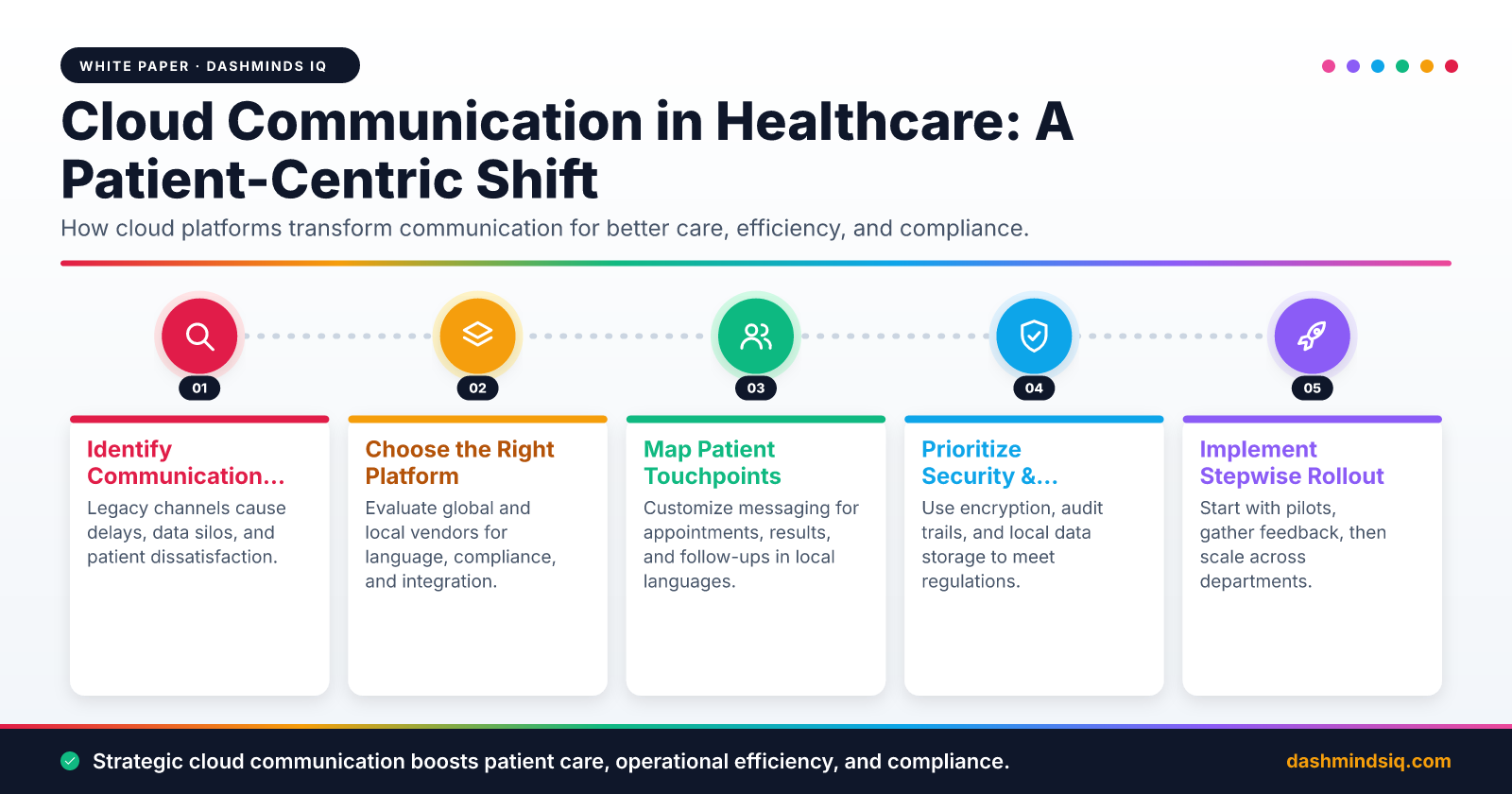
Adopting cloud communication in healthcare is a phased process. A disciplined roadmap reduces risk and lays the groundwork for sustainable success.
Stepwise Framework
- Assessment: Audit existing communication processes, map pain points, and define measurable objectives.
- Vendor Selection: Use the earlier checklist to shortlist and trial platforms.
- Integration Planning: Design how the platform will connect with EHR, telemedicine, billing, and patient portals. This often involves collaboration with IT and external partners—see our Backend & APIs Technology Services for integration support.
- Pilot: Launch with a single department or use case (e.g., appointment reminders), gather feedback, and iterate.
- Scale: Expand to other departments and workflows, refining based on real-world performance and user input.
Key Stakeholder Roles
- IT Leadership: Oversees architecture, security, and integration.
- Clinical Teams: Validate that workflows enhance care, not disrupt it.
- Operations: Owns training, SOP updates, and compliance monitoring.
- Patient Advocates: Ensure design reflects patient realities and feedback.
Mitigating Risks
| Pitfall | How to Avoid |
|---|---|
| Data migration errors | Run staged migrations, validate with test datasets |
| Downtime during cutover | Plan cutovers during off-peak hours, ensure rollback paths |
| User resistance | Invest in training, highlight patient and staff benefits |
| Over-customisation | Adopt standards-based integrations, avoid deep vendor lock-in |
| Compliance oversights | Engage legal/compliance early, automate audit reporting |
For infrastructure and cloud planning, our Cloud & Infrastructure Technology Services can provide expert guidance.
Measuring Success: KPIs and Continuous Improvement
No transformation is complete without clear measurement and ongoing optimisation. Establishing the right KPIs ensures alignment with patient-centric goals and regulatory obligations.
Defining Metrics
- Response Times: Track average time to respond to patient messages or escalations.
- Patient Satisfaction: Use surveys post-interaction to capture patient feedback on clarity, channel preference, and trust.
- Compliance Incidents: Monitor and log any data access or privacy violations.
- Operational Efficiency: Measure reduction in missed appointments, call volume, or manual workload.
Feedback Loops
- Solicit feedback from both patients and clinicians at every phase.
- Implement monthly or quarterly reviews of communication logs for compliance and efficiency.
- Use A/B testing for messaging channels and content.
Checklist: Continuous Improvement
- Are communication templates updated for clarity and language inclusivity?
- Is feedback from staff and patients reviewed and acted upon?
- Are new regulatory requirements promptly reflected in workflows?
- Is the platform usage data tracked for emerging bottlenecks or risks?
Continuous improvement is best supported by robust analytics and integration, as offered in our Data & Analytics Technology Services.
Frequently asked questions
How does cloud communication improve healthcare delivery?
Cloud communication streamlines and secures interactions between patients, clinicians, and administrative teams. It provides unified, accessible channels (voice, SMS, video, and messaging), integrates with EHR and telemedicine systems, and enables faster, more personalised care while lowering operational overhead.
What are the top cloud communication platforms for Indian healthcare?
Leading global platforms like Twilio, Vonage, and Plivo offer robust APIs, scalability, and security. Local Indian providers can offer better support for regional languages, compliance, and local regulations. The choice depends on integration needs, budget, and regulatory priorities.
How do I ensure data privacy and compliance when using cloud communication?
Select platforms that offer end-to-end encryption, robust authentication, and detailed audit logs. Prioritise vendors with experience in healthcare compliance (HIPAA, DISHA, NDHM), insist on clear data residency and processing agreements, and regularly review security practices in line with local regulations.
What are the main challenges in implementing cloud communication in hospitals?
Common challenges include integrating cloud platforms with legacy systems, managing change across staff and patients, ensuring multilingual accessibility, and maintaining continuous compliance. Successful projects start with phased pilots, strong stakeholder engagement, and rigorous risk management.
Is cloud communication cost-effective for small healthcare providers?
Yes, cloud communication reduces upfront IT investment and offers flexible, pay-as-you-go pricing. Smaller providers benefit from managed services, rapid deployment, and the ability to scale as their needs grow—without the burden of maintaining complex infrastructure.
Conclusion and Next Steps
Cloud communication is no longer an option but a strategic imperative for healthcare providers in India and similar markets. By embracing unified, secure, and patient-centric communication platforms, organisations can transform patient engagement, streamline clinical and administrative operations, and ensure regulatory compliance.
To move forward, we recommend:
- Assessing your current communication landscape and pain points.
- Engaging stakeholders across clinical, IT, and patient advocacy domains.
- Shortlisting platforms using our provided checklist and piloting with a focused use case.
- Committing to continuous improvement, leveraging analytics and feedback.
Ready to build a future-ready, patient-centric healthcare organisation? Explore how DashMinds IQ’s Technology Solutions & Engineering Services can guide your cloud communication strategy, or contact our team for a tailored consultation.