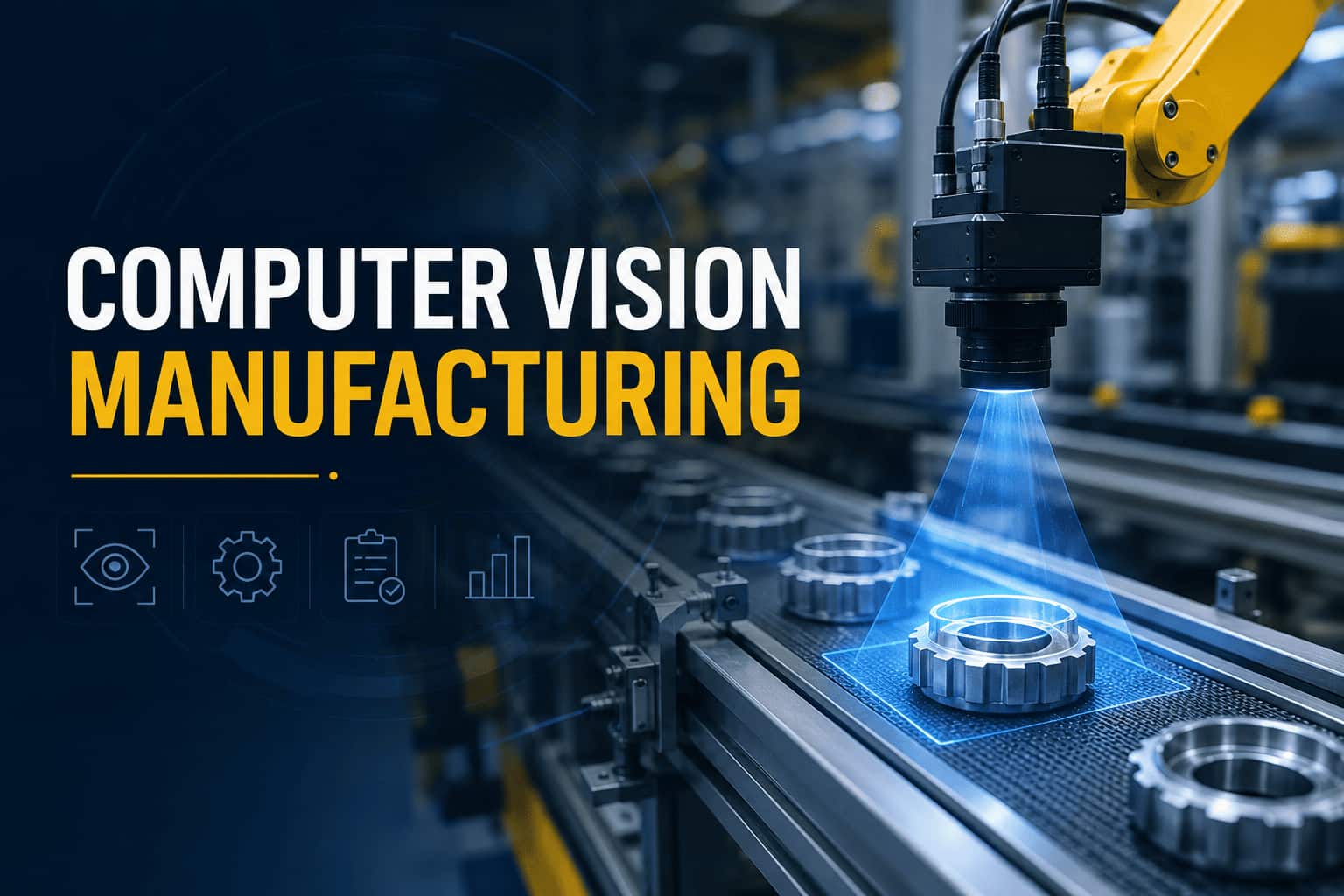
Manufacturers are under constant pressure to improve product quality, reduce waste, increase production efficiency, and respond faster to operational issues. Traditional manual inspection can struggle to keep pace with high-volume production, especially when quality decisions depend on speed, consistency, and close attention to detail.
This is where computer vision manufacturing solutions can create significant opportunities. By using cameras, image processing, machine learning, and artificial intelligence, manufacturers can automate visual inspection and gain deeper visibility into production processes.
However, investing in computer vision is not simply a matter of installing cameras on a production line. Businesses need to determine whether the technology fits their processes, data, infrastructure, workforce, and business objectives. Before making an investment, manufacturing leaders should evaluate several important factors.
Why Computer Vision Matters in Modern Manufacturing
Computer vision enables machines to interpret visual information from cameras and other imaging systems. In manufacturing, this capability can support applications such as defect detection, quality inspection, assembly verification, dimensional measurement, object detection, and production monitoring. DashMindsIQ develops computer vision systems designed for real-world business applications, helping organizations apply AI to quality control, industrial monitoring, defect detection, and other visual inspection requirements.
For example, a manufacturer producing automotive components could use an automated vision system to identify surface defects or verify whether a component has been assembled correctly.
The value goes beyond replacing manual inspection. Properly designed systems can help businesses create more consistent quality processes, identify production issues earlier, and generate useful operational data.
However, the technology delivers value only when it is connected to a clearly defined business problem.
1. Start With the Business Problem
The first question should not be, "Which computer vision system should we buy?"
Instead, ask:
"What manufacturing problem are we trying to solve?"
Potential objectives could include:
- Reducing product defects
- Improving inspection consistency
- Increasing inspection speed
- Reducing production waste
- Detecting missing or incorrectly positioned components
- Improving process monitoring
- Supporting worker safety
- Collecting better production-quality data
A clearly defined objective makes it easier to determine whether computer vision is the right solution.
For example, if the primary challenge is inconsistent manual inspection, automated visual inspection may be appropriate. If the problem is caused by poor production planning or unreliable equipment, computer vision alone may not address the root cause.
2. Evaluate the Inspection Process
Not every manufacturing inspection task is equally suitable for computer vision. Evaluate the existing process carefully.
Consider:
- What characteristics need to be inspected?
- Are defects visually identifiable?
- How frequently do defects occur?
- How much variation exists between acceptable products?
- How quickly must inspections be completed?
- What lighting conditions exist?
- Are products moving continuously?
- Does the product change frequently?
A highly standardized production line may be easier to automate than an environment where products, lighting, positioning, and inspection requirements change constantly. A feasibility assessment can help identify which inspection tasks should be automated first.
3. Consider Data and Image Quality
Computer vision systems depend heavily on the quality of the visual data they receive. Poor camera positioning, inadequate lighting, motion blur, reflections, inconsistent backgrounds, or low-resolution images can reduce system performance. Manufacturers should therefore assess:
Camera Requirements
The appropriate camera depends on factors such as resolution, field of view, speed, distance, and the characteristics of the objects being inspected.
Lighting
Lighting is particularly important for industrial computer vision. A defect that is easy for a human to see under one lighting condition may become difficult for a vision system to identify under another.
Training Data
AI-powered vision systems may require representative images showing both acceptable products and relevant defect types. The training data should reflect real production conditions rather than only ideal laboratory conditions.
4. Understand AI Model Requirements
Modern computer vision manufacturing solutions may use machine learning or deep learning models to identify patterns and anomalies. Before investing, businesses should understand how the model will be trained, tested, monitored, and updated.
Important questions include:
- How much labeled image data is available?
- What types of defects need to be detected?
- How frequently do product designs change?
- How will new defect patterns be incorporated?
- How will false positives and false negatives be managed?
- How will model performance be monitored after deployment?
A model that performs well during initial testing may require ongoing monitoring as production conditions evolve.
5. Check Integration With Existing Systems
Computer vision should not operate as an isolated technology. Manufacturers should examine how the solution will integrate with existing production and enterprise systems, including:
- Manufacturing execution systems (MES)
- Enterprise resource planning (ERP) platforms
- Industrial control systems
- Production databases
- IoT platforms
- Quality management systems
- Analytics platforms
For example, a detected defect could trigger a workflow in a manufacturing system, associate the event with a production batch, and provide quality information for further analysis. The stronger the integration, the greater the opportunity to turn visual inspection into actionable operational intelligence.
6. Evaluate Edge and Cloud Infrastructure
Manufacturers should also decide where computer vision processing should occur. Edge computing can be useful when inspection decisions need to happen close to the production line with minimal latency. Cloud infrastructure can be valuable for centralized data storage, analytics, model management, and processing across multiple facilities. In some environments, a hybrid architecture may be the most practical option. The decision should consider latency, connectivity, security, data volume, scalability, and operational requirements.
7. Calculate the Total Cost of Ownership
The cost of computer vision extends beyond cameras and software. A realistic investment assessment should consider:
- Cameras and imaging equipment
- Lighting
- Edge hardware
- Software and AI models
- System integration
- Data preparation
- Installation
- Maintenance
- Model retraining
- Employee training
- Infrastructure
- Ongoing monitoring
Businesses should compare these costs with measurable business objectives such as reduced inspection time, lower scrap, improved quality consistency, and reduced manual effort. The goal should be to evaluate business value rather than technology cost alone.
8. Plan for Scalability
A successful pilot does not automatically mean a successful enterprise deployment. Before investing, determine whether the solution can scale from one production line to multiple lines or facilities.
Consider whether the architecture can support:
- Additional cameras
- New product types
- Additional defect categories
- Multiple manufacturing locations
- Centralized model management
- Increasing image volumes
- Integration with additional systems
A scalable computer vision strategy prevents businesses from creating isolated solutions that become difficult to maintain later.
Common Mistakes to Avoid
Manufacturers can reduce implementation risk by avoiding several common mistakes.
Choosing Technology Before Defining the Problem
Starting with a technology rather than a business objective can result in an expensive system that does not address an important operational issue.
Underestimating Data Requirements
AI-based inspection requires representative data. Insufficient or poor-quality training images can affect system performance.
Ignoring Production Conditions
A system tested under controlled conditions may behave differently on a busy production floor.
Treating the Pilot as the Final Solution
A pilot should test technical feasibility and business value, but production deployment requires additional planning around integration, reliability, security, and scalability.
Focusing Only on Automation
The strongest solutions combine technology with appropriate human oversight, operational processes, and continuous improvement.
Business Benefits and Expected Outcomes
When properly planned and implemented, computer vision can support several manufacturing objectives.
Potential benefits include:
- More consistent quality inspection
- Faster detection of defects
- Improved production visibility
- Reduced manual inspection workload
- Better traceability
- Earlier identification of process problems
- More actionable production data
- Improved quality decision-making
The specific benefits will depend on the manufacturing environment, application, data quality, and implementation approach.
FAQ
Is computer vision suitable for every manufacturing business?
No. Suitability depends on the inspection problem, production environment, product characteristics, data availability, and expected business value.
Does computer vision replace human inspectors?
Not necessarily. Many manufacturers use computer vision to automate repetitive inspection tasks while keeping people involved in exception handling, quality decisions, and process improvement.
How important is lighting in industrial computer vision?
Extremely important. Consistent lighting can significantly influence image quality and the system's ability to identify relevant product characteristics.
Should computer vision processing happen in the cloud?
Not always. Edge processing may be preferable for real-time production decisions, while cloud platforms can support centralized analytics and model management. A hybrid architecture can combine both approaches.
What should manufacturers do before starting a computer vision project?
Start with a business and technical feasibility assessment. Define the problem, evaluate the inspection environment, assess available data, identify integration requirements, and establish measurable success criteria.
Conclusion
Investing in computer vision manufacturing technology can create meaningful opportunities for improving quality inspection, production visibility, and operational efficiency. But successful adoption requires more than selecting cameras or an AI model. Manufacturers should begin with a specific business problem, evaluate the production environment, understand data requirements, plan system integration, calculate total cost of ownership, and design for future scalability. A structured assessment can help organizations determine where computer vision can create the greatest value and whether a pilot is justified.
If your organization is evaluating computer vision, AI, or intelligent manufacturing solutions, DashMindsIQ can help assess the business opportunity, technology requirements, data environment, and implementation approach. Contact DashMindsIQ