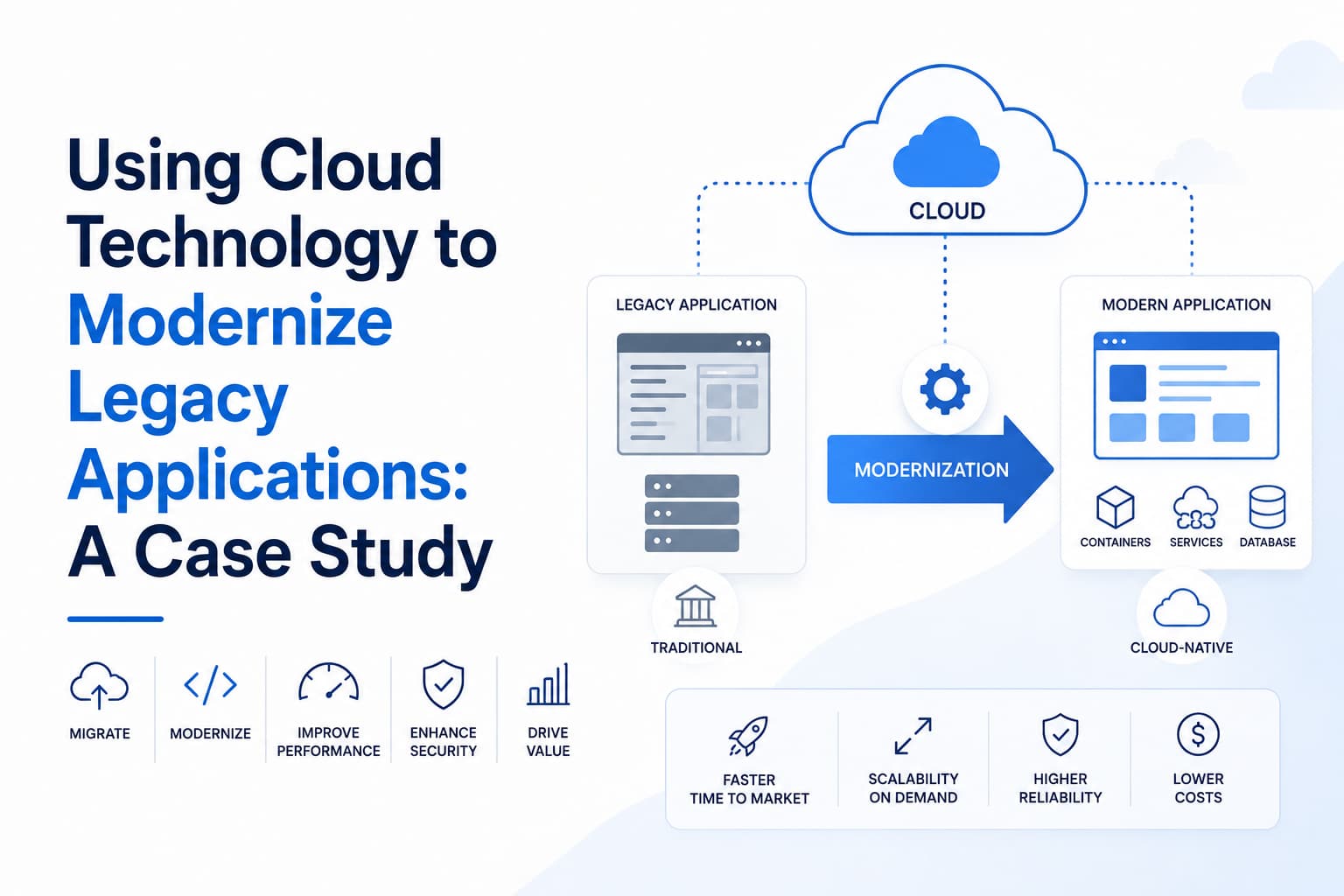
Business Challenge
Many enterprises rely on legacy applications that remain important to daily operations but are increasingly difficult to maintain, integrate, and scale. Older architectures can limit the organization's ability to introduce new capabilities or respond quickly to changing business requirements.
In this representative case study, the organization wanted to use cloud technology as part of its Legacy Application Modernisation strategy. The objective was not simply to move existing applications to the cloud, but to create a more flexible and sustainable application environment while maintaining business continuity.
Why It Matters
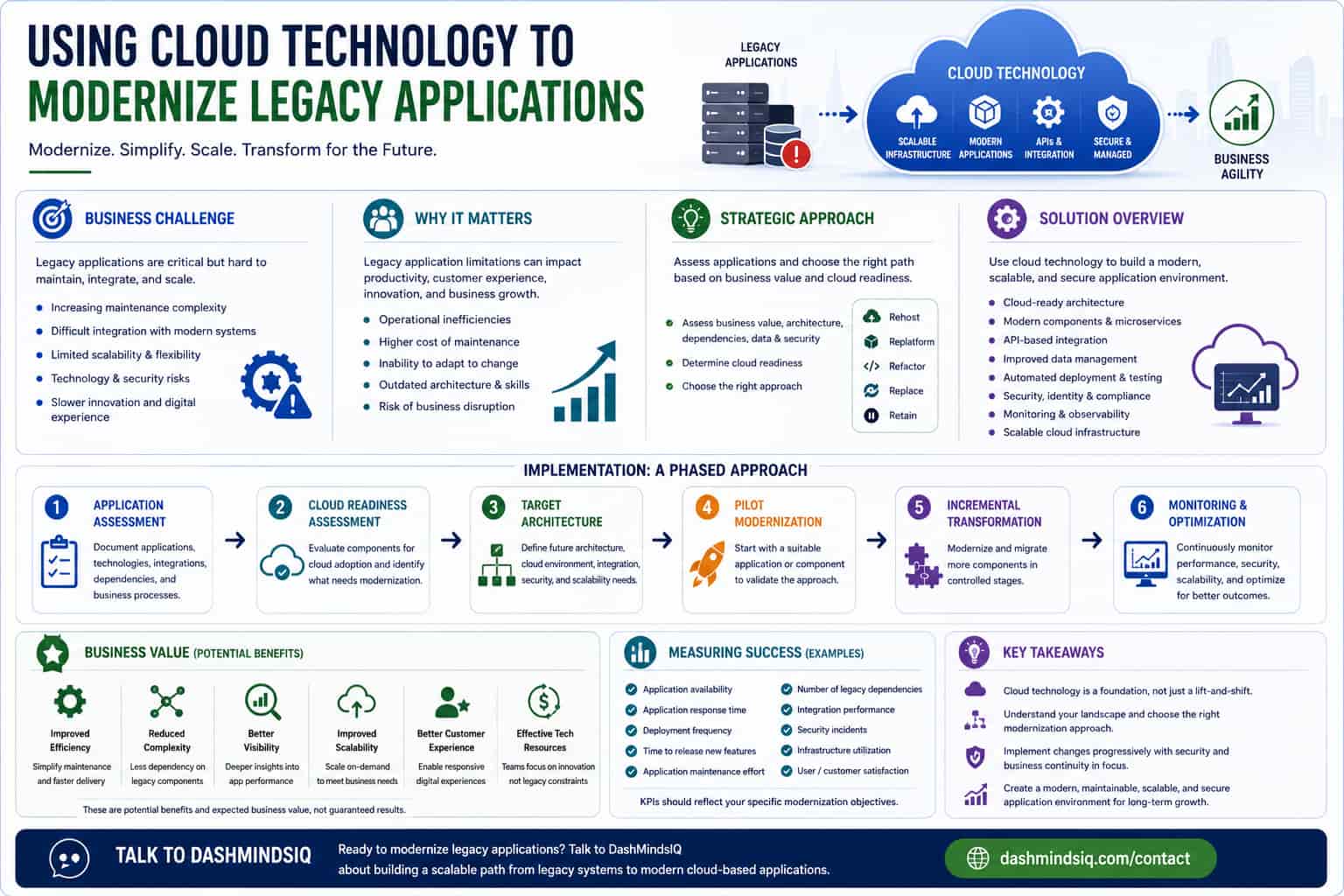
Legacy applications can create operational and business challenges, including:
- Increasing maintenance complexity
- Difficult integration with modern systems
- Limited scalability
- Slower application enhancements
- Technology and security risks
- Greater dependency on outdated architectures
- Challenges delivering modern digital experiences
For business leaders, these limitations can affect productivity, customer experience, innovation, and the organization's ability to scale.
Strategic Approach
The modernization strategy begins with understanding the existing application environment. Applications can be assessed based on business importance, architecture, dependencies, data requirements, security, integration complexity, and cloud readiness. Based on the assessment, the organization can determine whether an application should be rehosted, replatformed, refactored, replaced, or retained. This approach helps ensure that cloud adoption supports actual business objectives rather than becoming a simple infrastructure migration exercise.
Solution
The proposed solution uses cloud technology to create a more modern and scalable application environment.
Key capabilities can include:
- Cloud-ready application architecture
- Modern application components
- API-based integration
- Improved data management
- Automated deployment and testing
- Security and identity controls
- Application monitoring and observability
- Scalable cloud infrastructure
Where appropriate, legacy application components can be gradually modernized rather than replaced simultaneously. This can allow the organization to preserve important business functionality while progressively reducing dependence on outdated technology.
Implementation
A phased implementation approach can help manage modernization risk.
1. Application Assessment
Document existing applications, technologies, integrations, dependencies, and business processes.
2. Cloud Readiness Assessment
Determine which components are suitable for cloud adoption and which require additional modernization.
3. Target Architecture
Define the future application architecture, cloud environment, integration requirements, security controls, and scalability needs.
4. Pilot Modernization
Begin with a suitable application or component to validate the modernization approach.
5. Incremental Transformation
Modernize and migrate additional components in controlled stages while maintaining required business operations.
6. Monitoring and Optimization
After implementation, monitor application performance, security, scalability, and operational requirements and make improvements as needed.
Business Value
A well-planned Legacy Application Modernisation initiative can provide several potential benefits.
Improved efficiency: Modern development and deployment practices can simplify application maintenance and enhancement.
Reduced operational complexity: Modern architectures can reduce dependencies on tightly coupled legacy components.
Better visibility: Cloud monitoring and application observability can provide greater insight into application performance and health.
Improved scalability: Cloud infrastructure can provide greater flexibility as workloads and business requirements change.
Better customer experience: Modernized applications can support more responsive and flexible digital experiences.
More effective technology resources: Development and IT teams can spend less time working around legacy limitations and more time delivering business capabilities.
These represent potential benefits and expected business value, not guaranteed project results.
Measuring Success
Business and technology leaders can establish KPIs before beginning the modernization initiative. Relevant measures may include:
- Application availability
- Application response time
- Deployment frequency
- Time required to release new features
- Application maintenance effort
- Number of legacy dependencies
- Integration performance
- Security incidents
- Infrastructure utilization
- User or customer satisfaction
The appropriate KPIs should reflect the organization's specific modernization objectives.
Key Takeaways
Cloud technology can provide an important foundation for Legacy Application Modernisation, but successful transformation requires more than moving applications from on-premises infrastructure to the cloud. Organizations should first understand their application landscape, identify modernization priorities, select the appropriate transformation approach, and implement changes progressively. The goal should be to create an application environment that is easier to maintain, integrate, secure, and scale while supporting long-term business objectives.
Legacy Application Modernisation: Costs, Benefits, and Key Considerations
Modernizing legacy applications requires a strategy that balances technology transformation, business continuity, security, scalability, and long-term value. DashMindsIQ can help organizations assess legacy application environments, evaluate cloud modernization opportunities, define target architectures, and develop a practical Legacy Application Modernisation roadmap. Ready to modernize legacy applications? Talk to DashMindsIQ about building a scalable path from legacy systems to modern cloud-based applications.