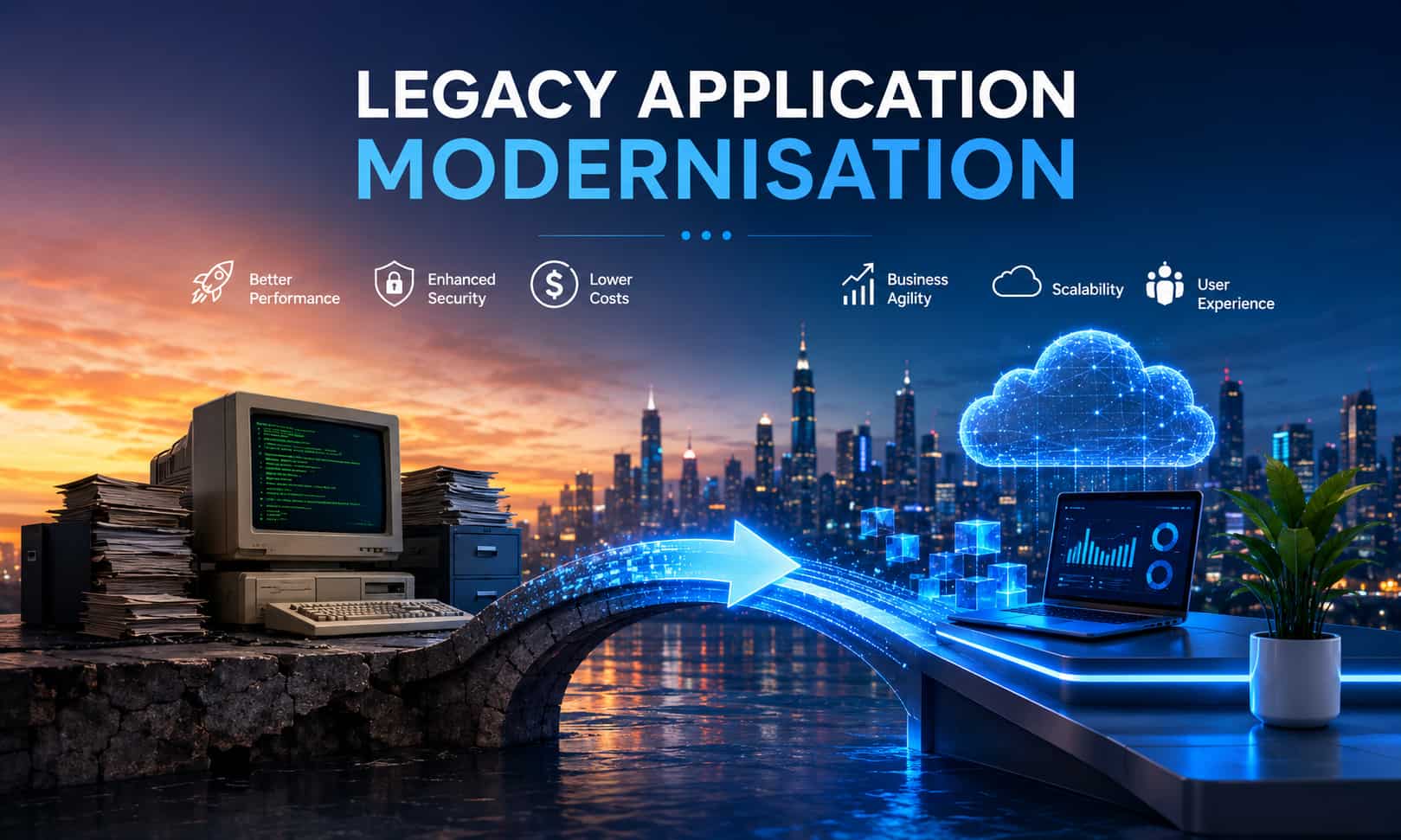
Legacy applications are often at the center of critical business operations. They may support finance, supply chains, customer services, manufacturing, internal workflows, or other essential processes. Yet over time, these systems can become expensive to maintain, difficult to integrate, slow to change, and increasingly dependent on outdated technology or specialized skills. The challenge for enterprise leaders is deciding what to do next. Should the organization retain the existing application and improve its infrastructure? Should it move the application to the cloud? Should the system be rearchitected, rebuilt, or replaced entirely?
Should the organization retain the existing application and improve its infrastructure? Should it move the application to the cloud? Should the system be rearchitected, rebuilt, or replaced entirely? There is no universal answer. A successful Legacy Application Modernisation strategy depends on the application's business value, technical condition, cost of ownership, security requirements, integration dependencies, and future role in the enterprise. This article provides a practical framework for evaluating modernization options and selecting an approach that balances cost, risk, scalability, and long-term business impact.
Why Legacy Application Modernisation Is a Business Decision
Legacy modernization is often described as a technology initiative, but its consequences extend far beyond IT. An outdated application can affect:
- Speed of product and service delivery
- Customer experience
- Operational efficiency
- Cybersecurity and compliance
- Integration with modern platforms
- Infrastructure and maintenance costs
- Availability of technical skills
- Ability to use cloud, data, automation, and AI capabilities
However, age alone does not mean an application should be replaced. Some older applications continue to deliver substantial business value and may require only targeted improvements. Others may have accumulated technical debt to the point where continued maintenance limits innovation. The goal of Legacy Application Modernisation is therefore not simply to use newer technology. It is to determine the most appropriate path for improving the application's business and technical value.
What Businesses Should Evaluate Before Modernizing
Before selecting a modernization approach, organizations should assess each application across several dimensions.
1. Business Value
Start by asking:
- How important is the application to business operations?
- Does it directly support revenue, customers, or critical processes?
- Is its functionality still strategically relevant?
- Will the application be needed over the next several years?
A high-value application may justify deeper modernization investment, while a low-value system may be a better candidate for retirement or replacement.
2. Technical Condition
Evaluate the application's architecture, codebase, dependencies, infrastructure, databases, and development practices. Important questions include:
- Is the technology still supported?
- Can skilled developers maintain it?
- How difficult is it to test or modify?
- Does it have significant technical debt?
- Can components be modernized independently?
3. Cost of Ownership
The cost of modernization should be compared with the cost of maintaining the current environment. Consider:
- Infrastructure costs
- Software licensing
- Maintenance and support
- Specialized skills
- Security remediation
- Downtime and operational disruption
- Integration complexity
- Future enhancement requirements
The cheapest short-term option may not always be the lowest-cost option over the application's remaining lifecycle.
4. Risk and Compliance
Applications handling sensitive data or regulated processes require additional assessment. Modernization decisions should evaluate:
- Data protection
- Identity and access management
- Vulnerability exposure
- Audit requirements
- Backup and recovery
- Business continuity
- Regulatory obligations
Security should be integrated into the modernization plan rather than added after the architecture is selected.
5. Integration and Dependency Complexity
Legacy applications rarely operate independently. A modernization project can affect APIs, databases, enterprise systems, third-party services, data pipelines, and user interfaces. Dependency mapping is therefore essential before major changes are made.
Major Legacy Application Modernisation Approaches
Organizations generally have several options, and these approaches can also be combined across different applications or components. Retain: Keep the application largely unchanged. This causes the least immediate disruption but allows existing technical debt to remain. It is suitable when the system is stable and there are limited strategic reasons for change. DashMindsIQ helps organizations evaluate legacy applications and determine whether retaining, re-platforming, refactoring, or modernizing a system is the most practical approach, considering business priorities, technical dependencies, scalability, security, and long-term maintenance requirements.
Rehost: Move the application to new or cloud infrastructure with minimal changes. This enables faster migration and greater infrastructure flexibility, but it may not solve existing architectural limitations. It is suitable when infrastructure modernization is the immediate priority.
Replatform: Make selected improvements to the application while migrating it. This balances modernization with complexity, although some core legacy limitations may remain. It works well when targeted improvements can provide sufficient business value.
Refactor: Redesign parts of the application's architecture or codebase. This can significantly improve scalability and maintainability, but it requires greater investment and technical effort. It is suitable for applications with strong long-term business value.
Replace: Move the application's functionality to a modern packaged solution or SaaS platform. This can reduce the maintenance burden, but it may involve significant business process changes and migration complexity. It is suitable when standard functionality can be effectively supported by another platform.
Rebuild: Create a completely new application from the ground up. This provides the greatest architectural flexibility but also carries the highest delivery, cost, and transition risks. It is suitable when the existing architecture can no longer support future business requirements.
Understanding the Trade-Offs
Rehosting: Fast Infrastructure Modernization
Rehosting, sometimes called a lift-and-shift approach, moves an application to a new hosting environment with relatively limited application changes. Advantages:
- Faster migration path
- Reduced dependence on aging infrastructure
- Lower application-level change risk
- Can support broader cloud migration initiatives
Limitations:
- Existing technical debt may remain
- The application may not fully benefit from cloud-native capabilities
- Cost efficiency depends on architecture and resource management
Rehosting can make sense when infrastructure risk is urgent or when an organization needs time to plan deeper modernization.
Replatforming: Targeted Improvement
Replatforming involves making selected changes while moving the application to a new environment. For example, an organization may adopt managed databases, modern runtime environments, or improved deployment processes without completely redesigning the application.
Advantages:
- Moderate transformation effort
- Can improve maintainability and operational efficiency
- Supports incremental modernization
Limitations:
- Some architectural constraints remain
- Benefits depend on selecting the right components to change
This approach is often suitable when a complete rewrite would create unnecessary risk.
Refactoring: Modernizing the Architecture
Refactoring changes the application architecture or code to improve scalability, maintainability, integration, and development speed. This may involve APIs, microservices, containers, event-driven architecture, or other modern application patterns where appropriate.
Advantages:
- Greater long-term flexibility
- Improved scalability
- Better integration opportunities
- Potentially stronger automation and development practices
Limitations:
- Higher investment and technical complexity
- Requires detailed architectural planning
- May expose hidden dependencies
Refactoring is often appropriate for strategically important applications that will continue to evolve.
Replacing or Rebuilding
Replacement involves adopting another application or SaaS platform, while rebuilding creates a new application designed around current requirements.
Advantages:
- Opportunity to eliminate outdated architecture
- Can simplify technology environments
- Enables redesigned business processes and user experiences
Limitations:
- Significant implementation effort
- Data migration challenges
- Change management requirements
- Risk of recreating old problems in a new system
These options should be evaluated carefully rather than selected simply because the existing application is old.
The VALUE Decision Framework
To make Legacy Application Modernisation decisions more structured, enterprise leaders can use the VALUE Framework.
V — Value to the Business
Assess strategic importance, customer impact, operational criticality, and future relevance.
A — Architecture and Technical Health
Evaluate code quality, dependencies, scalability, maintainability, and technology support.
L — Lifecycle Cost
Compare current maintenance costs with modernization, replacement, and future operating costs.
U — Uncertainty and Risk
Assess migration risk, security exposure, compliance requirements, data complexity, and business continuity concerns.
E — Evolution Requirements
Determine how much the application must change in the future. An application with limited future change requirements may not justify a major rebuild. A strategically important application requiring frequent innovation may justify deeper modernization. The VALUE Framework helps leaders avoid making decisions based on a single factor such as cloud readiness or current infrastructure cost.
Which Approach Fits Different Business Situations?
Situation 1: Stable Application With Limited Change Requirements
Consider: Retain or rehost. If the application is reliable and its functionality remains appropriate, major redevelopment may create unnecessary cost and risk.
Situation 2: Application Works but Is Expensive to Operate
Consider: Replatform. Targeted infrastructure, database, automation, or operational improvements may address the primary business problem.
Situation 3: Strategic Application That Cannot Scale or Integrate Easily
Consider: Refactor. This may be appropriate when the application is central to future digital products, customer experiences, or data initiatives.
Situation 4: Outdated Application Supporting Standard Business Processes
Consider: Replace. A modern packaged platform may be more practical than continuing to maintain custom legacy functionality.
Situation 5: Architecture Cannot Support Future Requirements
Consider: Rebuild. A new application may be justified when incremental modernization would be more complex than creating a sustainable replacement.
Cost, Performance, and Scalability Considerations
Modernization budgets should account for more than development costs. Evaluate:
- Application discovery and assessment
- Architecture and design
- Data migration
- Integration changes
- Testing
- Security controls
- Infrastructure
- Licensing
- Skills and training
- Change management
- Parallel operations during transition
Scalability should also be tied to actual business demand. Not every application requires a highly distributed architecture. Similarly, performance improvements should be measured against user and business requirements rather than assumed to result from moving to newer technology.
Common Legacy Modernization Mistakes
Modernizing Without a Business Case
Technology upgrades should be connected to measurable business or operational outcomes.
Trying to Modernize Everything at Once
Large portfolios are usually better addressed through prioritization and phased roadmaps.
Ignoring Dependencies
Changing one application can affect many upstream and downstream systems.
Choosing a Technology Before Understanding the Problem
Cloud, microservices, containers, or AI are not modernization strategies by themselves.
Underestimating Data Migration
Data quality, mapping, retention, security, and reconciliation should be assessed early.
Measuring Success Only by Project Completion
A migration can be completed on schedule while failing to improve maintainability, cost efficiency, resilience, or business outcomes.
How to Measure Modernization Success
Define success measures before implementation. Potential indicators include:
- Reduction in unsupported technology dependencies
- Improvement in deployment and release processes
- Application availability and reliability
- Performance against defined requirements
- Reduced maintenance complexity
- Improved security posture
- Integration efficiency
- Scalability under expected demand
- Progress in reducing technical debt
- Business outcomes associated with the application
The right metrics should reflect the original reason for modernization.
FAQs
What is Legacy Application Modernisation?
Legacy Application Modernisation is the process of improving, transforming, migrating, replacing, or rebuilding existing applications so they can better support current business, security, scalability, and technology requirements.
Is cloud migration the same as application modernization?
No. Cloud migration focuses on moving workloads to a cloud environment. Modernization may involve infrastructure changes, application redesign, code refactoring, replacement, or other improvements. Cloud migration can be part of a broader modernization strategy.
Is rebuilding always better than modernizing an existing application?
No. Rebuilding can provide greater flexibility, but it also introduces cost, delivery risk, and transition complexity. Incremental modernization may be more suitable when the existing application has valuable functionality and manageable technical constraints.
How should businesses prioritize legacy applications?
Assess business value, technical health, cost, risk, security, dependencies, and future evolution requirements. A portfolio-based assessment is generally more effective than applying the same approach to every application.
What is the first step in Legacy Application Modernisation?
The first step is application discovery and assessment. Businesses need to understand what applications they have, how they are used, what they depend on, and which systems should be prioritized.
Final Recommendation: Modernize Based on Business Value, Not Technology Fashion
The most effective Legacy Application Modernisation strategy is not necessarily the most technically ambitious one. Some applications should be retained. Others may benefit from rehosting or replatforming. Strategic systems may justify refactoring, while replacement or rebuilding may make sense when the existing architecture no longer supports future business needs. The key is to make decisions systematically.
Use the VALUE Framework—Value, Architecture, Lifecycle Cost, Uncertainty, and Evolution—to assess each application, compare realistic options, and build a modernization roadmap based on business priorities. DashMindsIQ can help enterprise teams assess legacy application portfolios, evaluate modernization options, define migration and modernization roadmaps, and design practical architectures that balance cost, security, scalability, and long-term business objectives. A structured assessment is often the best starting point for turning a complex legacy estate into a prioritized and actionable modernization strategy.