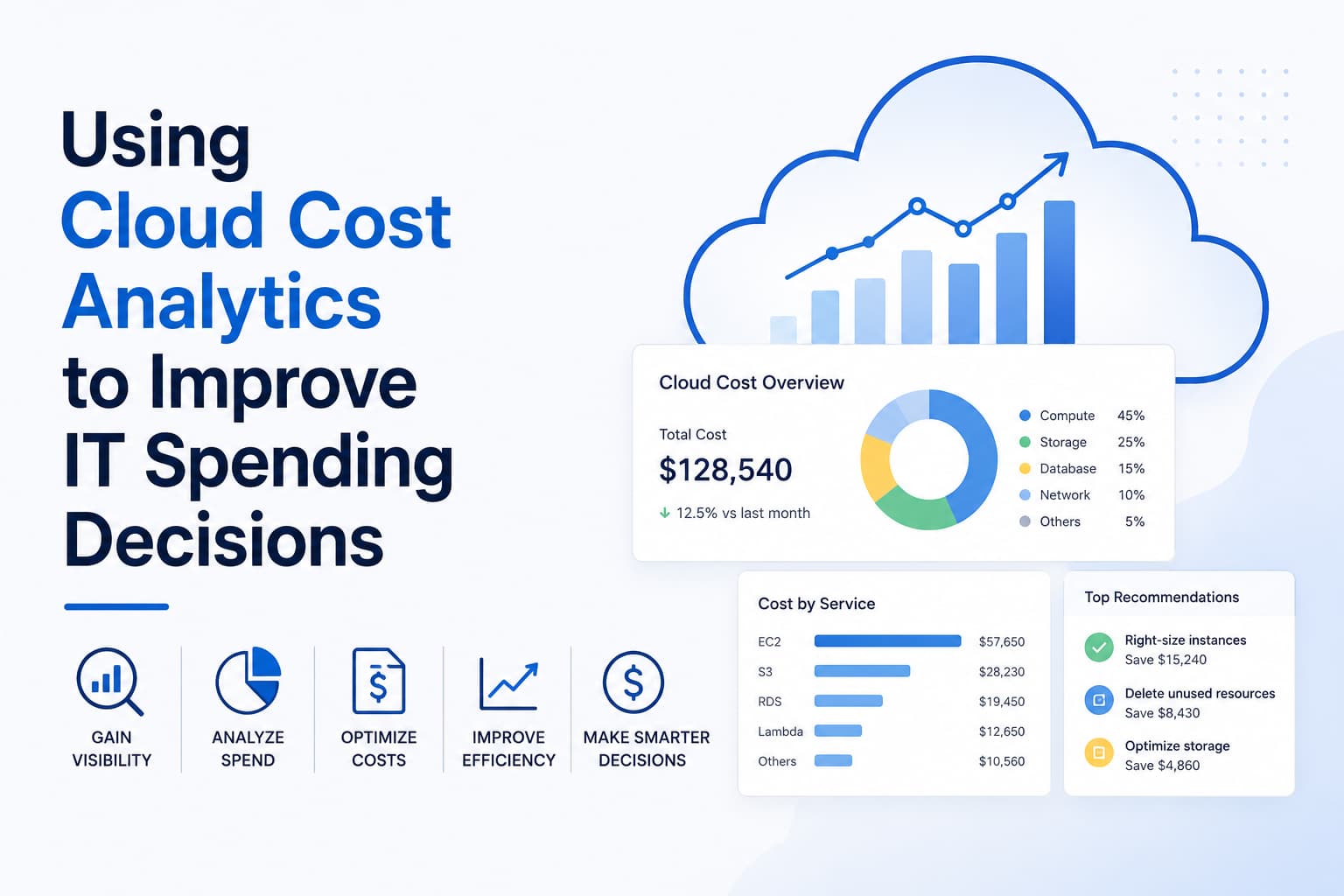
Industry Context
Cloud adoption has become essential for modern enterprises supporting applications, data platforms, analytics, and digital services. However, as cloud environments grow, controlling expenditure can become increasingly challenging.
Multiple teams may provision resources independently, workloads can fluctuate, and cloud usage may span different accounts, environments, and services.
This representative case study explores how Cloud Cost Optimisation / FinOps practices and cloud cost analytics can help organizations improve spending visibility and make more informed IT investment decisions.
Business Challenge
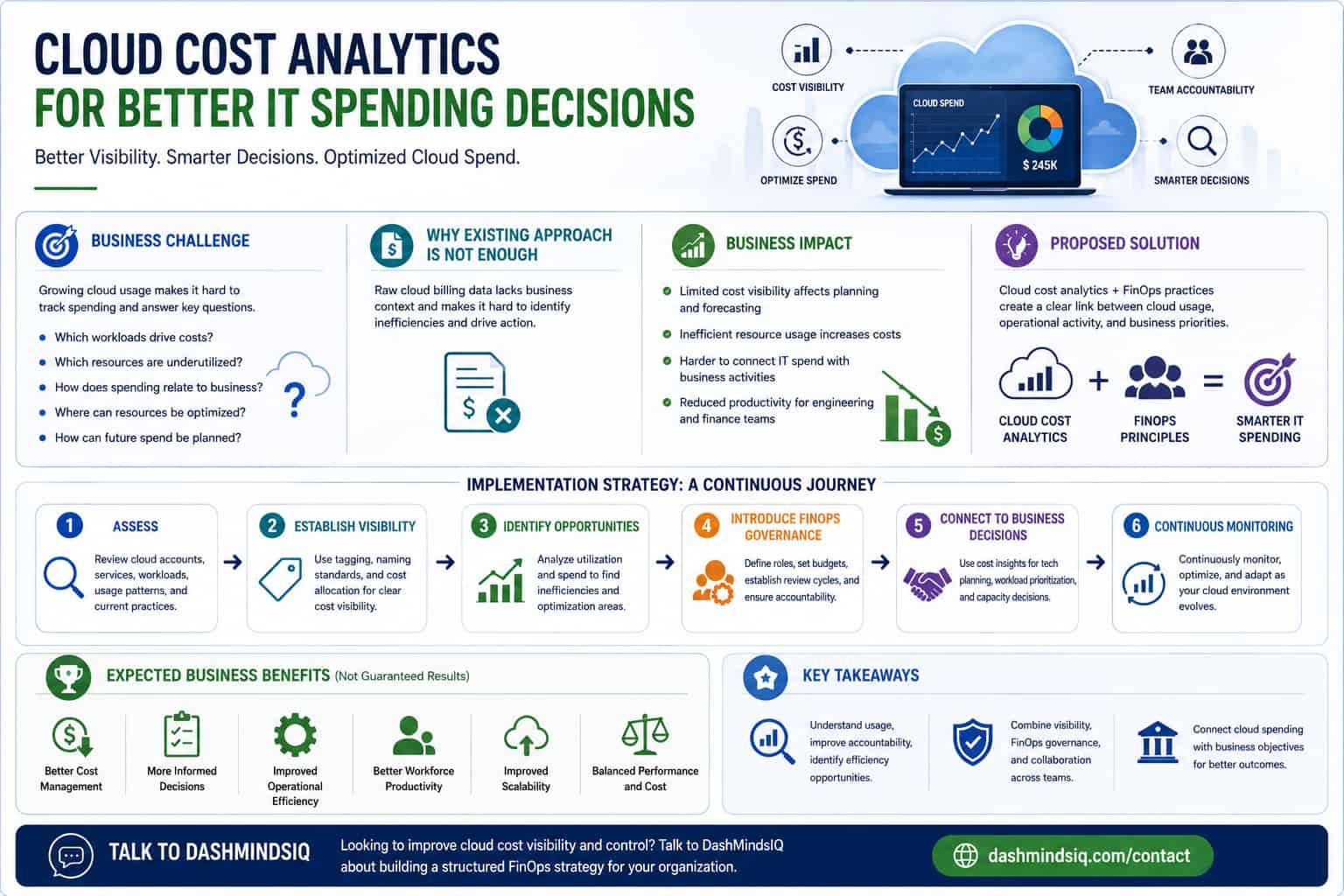
The organization operated a growing cloud environment supporting multiple business and technology workloads. While cloud infrastructure provided flexibility, understanding where and why expenditure was increasing became more difficult. Teams needed clearer answers to questions such as:
- Which workloads drive cloud expenditure?
- Which resources are underutilized?
- How does spending relate to business activities?
- Which teams or environments are responsible for costs?
- Where can resources be optimized?
- How can future cloud expenditure be planned?
The challenge was not simply reducing the cloud bill. The organization needed greater cost visibility, accountability, and decision-making capability.
Why the Existing Approach Was Not Enough
Traditional cloud billing provides spending information, but raw billing data does not always explain the business context behind costs. A monthly invoice may show that expenditure increased without clearly identifying which workloads, teams, or usage patterns caused the change. Without proper categorization and analysis, technology teams can also struggle to distinguish necessary infrastructure spending from potential cloud waste. This can make it harder to prioritize optimization while maintaining performance, availability, security, and customer experience.
Business and Operational Impact
Limited cost visibility can affect technology planning, forecasting, and resource allocation. Technology leaders may struggle to forecast future cloud requirements, while engineering teams may lack clear guidance on efficient resource usage. Finance teams may also find it difficult to connect technology expenditure with business activities. For organizations with rapidly expanding cloud environments, these challenges can become increasingly complex.
Proposed Technology Solution
DashMindsIQ's approach combines cloud cost analytics with FinOps principles to create a clearer relationship between cloud consumption, operational activity, and business priorities. A cloud cost analytics solution can consolidate billing and usage information into meaningful views covering:
- Spending by workload
- Costs by team or business unit
- Environment-level expenditure
- Resource utilization
- Spending trends
- Optimization opportunities
- Budgets and forecasts
FinOps practices can then establish shared accountability between engineering, finance, and business stakeholders.
Implementation Strategy
1. Assess the Cloud Environment
Review cloud accounts, services, workloads, usage patterns, and existing cost-management practices.
2. Establish Cost Visibility
Organize billing and usage information using consistent tagging, naming, account structures, and cost-allocation methods.
3. Identify Optimization Opportunities
Analyze utilization and spending patterns to identify potential inefficiencies, such as underutilized resources, unnecessary capacity, or inefficient configurations.
4. Introduce FinOps Governance
Establish responsibilities, review cycles, budgets, and accountability across relevant teams.
5. Connect Cost Data With Business Decisions
Incorporate cloud spending insights into technology planning, workload prioritization, and capacity decisions.
6. Continuously Monitor
Because cloud environments constantly change, cost management should be treated as an ongoing process rather than a one-time exercise.
Expected Business Benefits
Because this is a representative scenario, these are expected benefits rather than proven project results.
Better Cost Management
Improved visibility can help teams understand where expenditure occurs and investigate potential inefficiencies.
More Informed Decisions
Technology leaders can use spending and usage trends when evaluating infrastructure and application decisions.
Improved Operational Efficiency
Automated reporting and clearer ownership can reduce manual effort involved in tracking cloud expenditure.
Better Workforce Productivity
Engineering and finance teams can spend less time reconciling unclear costs and more time focusing on optimization and strategic priorities.
Improved Scalability
A consistent FinOps framework can support additional workloads, teams, and cloud environments as the organization grows.
Balanced Performance and Cost
Cost optimization should not compromise application performance or availability. A data-driven approach can help organizations balance financial and operational requirements.
Scalability and Future Opportunities
As organizations adopt more services, environments, and cloud platforms, cost management becomes increasingly important. The organization can extend the approach through advanced forecasting, automated alerts, usage analysis, and policy-based governance. In multi-cloud environments, a consistent FinOps framework can also provide a common approach to understanding expenditure across platforms. Over time, cloud cost analytics can become part of broader technology governance and investment planning.
Key Takeaways
Cloud cost optimization is not simply about cutting expenditure. Effective Cloud Cost Optimisation / FinOps focuses on understanding usage, improving accountability, identifying efficiency opportunities, and connecting technology spending with business objectives. A successful approach combines accurate cost visibility, usage analysis, cost allocation, FinOps governance, cross-functional collaboration, continuous optimization, and business-focused decision-making.
Talk to DashMindsIQ
Managing cloud expenditure effectively requires more than reviewing monthly invoices. Businesses need clear cost ownership, usage visibility, practical optimization processes, and a strategy connecting cloud spending with business priorities. DashMindsIQ can help organizations assess their cloud cost-management environment, identify optimization opportunities, and develop a Cloud Cost Optimisation / FinOps approach aligned with their technology and business requirements.