Introduction
Equipment reliability is critical for businesses that depend on machinery, industrial assets, and connected infrastructure. Unexpected failures can disrupt operations, increase maintenance pressure, and make resource planning difficult.
This representative case study explores how an organization could use Predictive Maintenance IoT capabilities combined with AI to move from reactive equipment management toward a more proactive, data-driven maintenance approach.
BEFORE: Reactive Maintenance and Limited Asset Visibility
The Organization's Situation
The organization relied on scheduled inspections, maintenance records, and responses to reported equipment issues. As the number of assets increased, maintaining consistent visibility became more challenging. Maintenance teams needed better information about equipment conditions between scheduled inspections and wanted to identify changes that could indicate developing problems.
Existing Challenges
Key challenges included:
- Limited real-time asset visibility
- Dependence on scheduled maintenance
- Difficulty identifying early equipment deterioration
- Manual equipment monitoring
- Reactive responses to unexpected issues
- Maintenance data spread across different systems
Operational Impact
When equipment problems are discovered late, maintenance teams may have fewer opportunities to plan an appropriate response. Unexpected maintenance can also place additional pressure on operations and maintenance personnel. The organization's primary requirement was to improve asset visibility and support better maintenance decisions without creating unnecessary technology complexity.
APPROACH: Building an AI-Powered Predictive Maintenance Strategy
Assessing the Maintenance Challenge
DashMindsIQ's approach begins by understanding the organization's assets, maintenance processes, available data, and operational priorities. Rather than applying the same model to every asset, the organization can identify critical equipment where improved monitoring could provide the greatest potential value.
The assessment can consider:
- Asset criticality
- Sensor availability
- Historical maintenance records
- Operating conditions
- Existing monitoring systems
- Data quality
- Integration requirements
- Security and scalability
Combining IoT and AI
The strategy combines IoT-based equipment monitoring with AI and predictive analytics. IoT sensors can collect information such as temperature, vibration, pressure, energy consumption, and other relevant operational signals. AI and machine learning can then analyze historical and real-time data to identify unusual patterns or changes in expected equipment behavior.
A simplified workflow is:
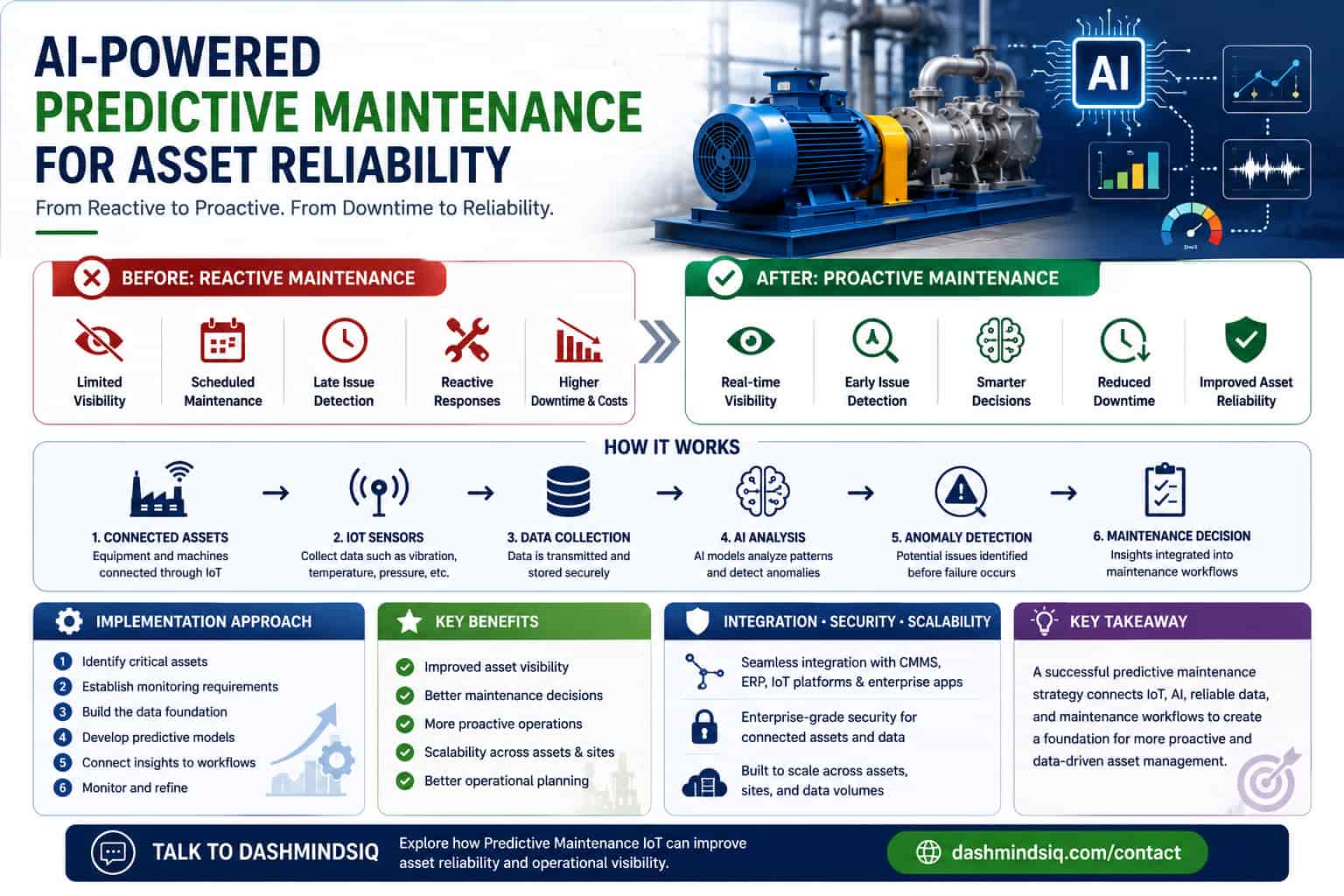
Connected Assets → IoT Sensors → Data Collection → AI Analysis → Anomaly Detection → Maintenance Decision
The objective is not simply to generate more alerts. It is to provide useful insights that help maintenance teams prioritize investigation and action.
Implementation Approach
1. Identify Critical Assets
Begin with assets where unexpected failures could have significant operational consequences.
2. Establish Monitoring Requirements
Determine which equipment conditions should be monitored and what sensor data is relevant.
3. Build the Data Foundation
Organize and process collected information so it can support analytics and AI models.
4. Develop Predictive Models
Evaluate AI models using relevant historical and real-time equipment data to identify abnormal operating patterns.
5. Connect Insights to Maintenance Workflows
Integrate predictive insights with existing maintenance processes so teams can investigate and prioritize potential issues.
6. Monitor and Refine
Continuously evaluate the system as equipment conditions, operating environments, and maintenance requirements change.
Integration, Security, and Scalability
An enterprise Predictive Maintenance IoT solution should fit within the organization's broader technology environment. Depending on the architecture, it may need to connect with maintenance management platforms, operational systems, IoT platforms, analytics environments, or enterprise applications. Security is also important when connected equipment generates operational data across multiple locations. The solution should also support future expansion across additional assets, sensors, facilities, and data volumes.
AFTER: Expected Business Value
Following implementation, the organization could establish a more proactive approach to asset management.
Improved Asset Visibility
Continuous monitoring can provide greater visibility into equipment conditions between scheduled inspections.
Better Maintenance Decisions
AI-driven insights can help teams prioritize equipment requiring investigation instead of relying exclusively on fixed maintenance schedules.
More Proactive Operations
Earlier identification of abnormal equipment behavior can provide an opportunity to investigate potential issues before they become more significant operational problems.
Scalability Opportunities
After validating the approach, predictive monitoring can potentially be extended to additional assets, production lines, or facilities.
Better Operational Planning
Improved asset information can support maintenance planning, resource allocation, and broader operational decision-making. These are expected outcomes, not guaranteed results. Actual value depends on equipment characteristics, data quality, implementation design, integration, and user adoption.
Key Takeaways
An effective Predictive Maintenance IoT strategy is not simply about installing sensors or deploying an AI model. The strongest approach connects critical asset identification, IoT monitoring, reliable data, AI analytics, maintenance workflows, enterprise integration, security, and continuous improvement. For organizations managing complex equipment environments, this approach can create a foundation for more proactive and data-driven asset management.
Talk to DashMindsIQ
Moving from reactive maintenance to intelligent asset management requires more than connected sensors. Businesses need the right combination of IoT, AI, data, integration, and operational strategy. DashMindsIQ can help organizations assess predictive maintenance opportunities, identify suitable use cases, design the technology approach, and build scalable solutions aligned with their operational requirements. If your organization is exploring Predictive Maintenance IoT to improve asset reliability and operational visibility, talk to DashMindsIQ about your requirements.