1. Executive Overview
Enterprise cloud migration can improve scalability, flexibility, and operational efficiency. However, moving applications, data, and workloads from existing environments to the cloud can also introduce technical and business risks.
A structured Cloud Migration Strategy helps organizations manage these risks by treating migration as a transformation journey rather than a simple infrastructure move.
This representative case study explores how an enterprise can reduce migration risk through assessment, workload prioritization, security planning, phased implementation, and continuous validation.
2. Business Situation
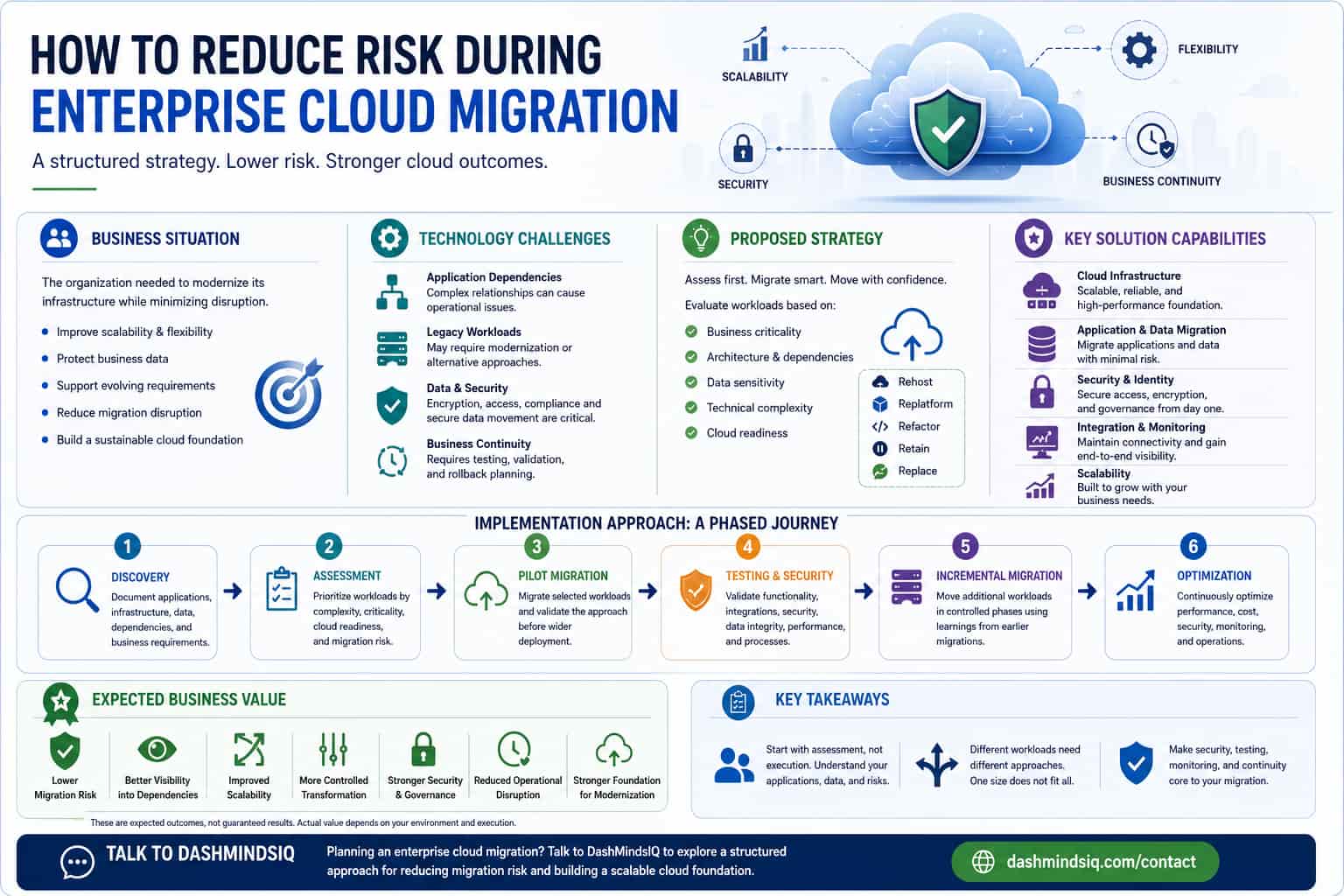
The organization operated a combination of legacy applications, infrastructure, databases, and business systems. As requirements evolved, the existing environment became increasingly difficult to scale and manage. The organization wanted to adopt cloud technology while minimizing disruption to business operations.
Key objectives included:
- Improving infrastructure scalability
- Increasing operational flexibility
- Protecting business data
- Supporting evolving business requirements
- Reducing migration-related disruption
- Establishing a sustainable cloud foundation
The challenge was determining which workloads should move first and which required modernization or an alternative approach.
3. Technology Challenges
Enterprise environments often contain applications with different architectures, dependencies, data requirements, and levels of business criticality.
Application Dependencies: Applications may rely on databases, APIs, authentication services, and other systems. Moving components without understanding these relationships can create operational problems.
Legacy Workloads: Older applications may not be cloud-ready and could require modernization, refactoring, or another migration approach.
Data and Security: Encryption, access controls, governance, compliance, and secure data movement must be considered throughout migration.
Business Continuity: Critical applications require appropriate testing, validation, rollback planning, and continuity measures.
4. Proposed Cloud Migration Strategy
DashMindsIQ's approach begins with discovery and assessment rather than immediately moving workloads. Applications can be evaluated based on business criticality, architecture, dependencies, data sensitivity, technical complexity, and cloud readiness.
Depending on the assessment, organizations may consider:
- Rehosting suitable workloads
- Replatforming applications where appropriate
- Refactoring applications requiring modernization
- Retaining workloads that are not currently suitable
- Replacing applications where alternatives provide greater value
This prevents a single migration approach from being applied across the entire enterprise.
5. Key Solution Capabilities
A practical cloud architecture should address several areas.
Cloud Infrastructure
The target environment should provide the scalability, reliability, and performance required by business workloads.
Application and Data Migration
Applications and associated data should be migrated according to dependencies and business requirements.
Security and Identity
Identity management, access controls, encryption, network security, and governance should be incorporated from the beginning.
Integration and Monitoring
APIs and integration services can maintain connectivity with existing systems, while monitoring and observability provide visibility into application and infrastructure performance.
Scalability
The architecture should support future workloads and changing business requirements.
6. Implementation Approach
A phased implementation can reduce migration risk.
Phase 1: Discovery
Document applications, infrastructure, data, dependencies, and business requirements.
Phase 2: Assessment
Prioritize workloads according to complexity, criticality, cloud readiness, and migration risk.
Phase 3: Pilot Migration
Migrate selected workloads and validate the approach before wider deployment.
Phase 4: Testing and Security
Validate functionality, integrations, access controls, data integrity, performance, and operational processes.
Phase 5: Incremental Migration
Move additional workloads in controlled phases using lessons from earlier migrations.
Phase 6: Optimization
Review performance, resource utilization, security, monitoring, and operational processes after migration.
7. Expected Business Value
Because specific project results were not provided, these represent expected business outcomes rather than guaranteed results.
A structured Cloud Migration Strategy can help organizations achieve:
- Lower migration risk
- Better visibility into dependencies
- Improved scalability
- More controlled transformation
- Stronger security and data governance
- Reduced operational disruption
- Greater flexibility
- A stronger foundation for modernization
8. Key Takeaways
Enterprise cloud migration should begin with assessment rather than execution. Understanding application dependencies, business priorities, security requirements, and technical readiness can help organizations make better migration decisions. Different workloads may require different approaches, while security, testing, monitoring, and business continuity should remain core parts of the migration process. Cloud migration should also be viewed as an ongoing transformation. After migration, organizations can continue optimizing architecture, costs, security, and performance.
9. Talk to DashMindsIQ
Enterprise cloud migration requires more than selecting a cloud platform. Businesses need a clear strategy covering applications, data, security, integration, testing, scalability, and long-term operations. DashMindsIQ can help organizations assess their technology environment, identify migration priorities, develop a practical Cloud Migration Strategy, and plan a phased transformation aligned with business objectives.