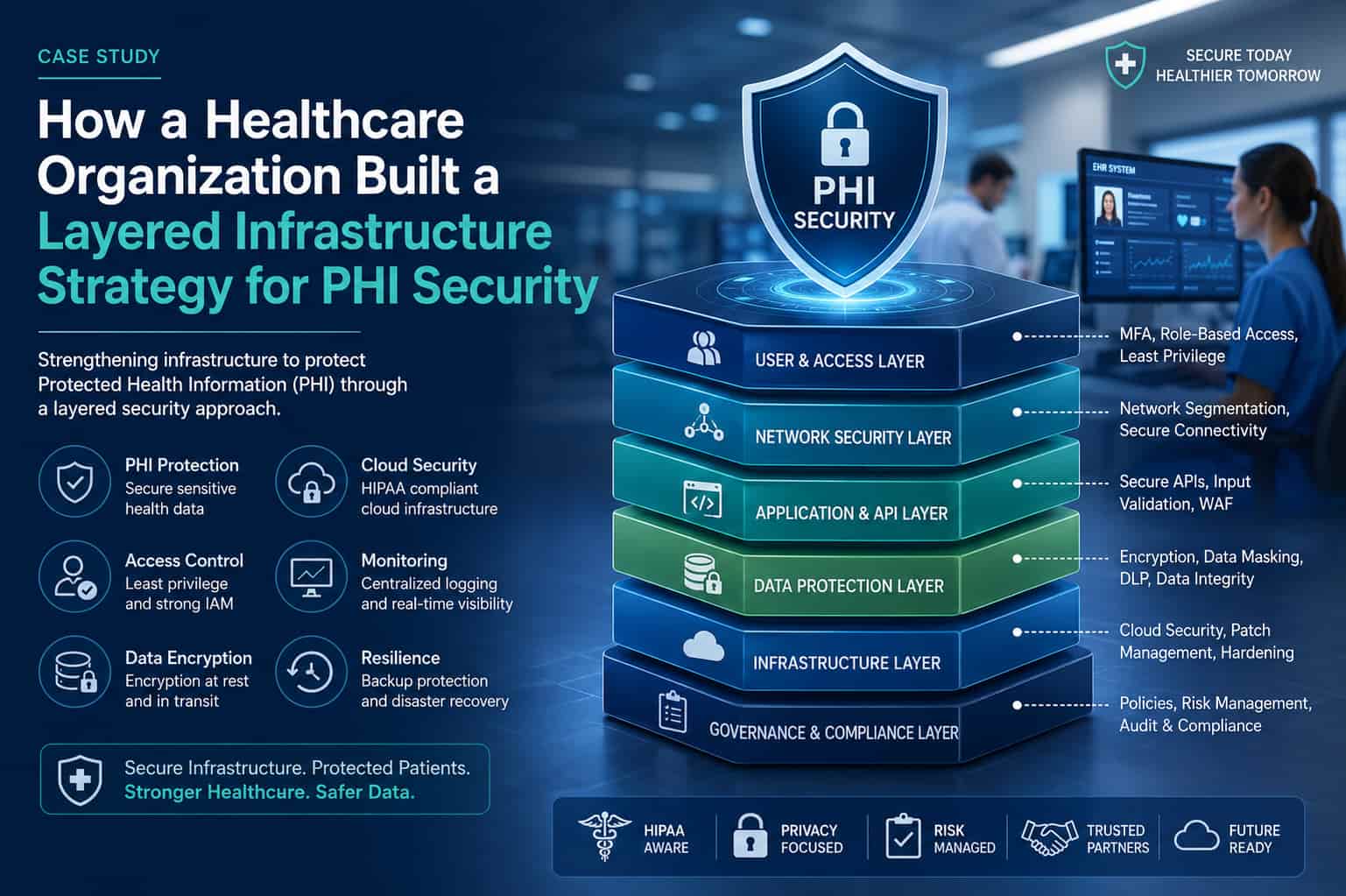
How a Healthcare Organization Built a Layered Infrastructure Strategy for PHI Security
Healthcare organizations increasingly depend on connected applications, cloud platforms, APIs, databases, remote access, and third-party services to deliver and manage healthcare operations. As these environments grow, protecting Protected Health Information (PHI) requires more than securing an individual application or deploying a single security product.
A representative healthcare organization faced this challenge while modernizing its technology environment. Its objective was to establish a stronger infrastructure foundation for PHI security while supporting new digital services and maintaining operational resilience. DashMindsIQ helped the organization approach this transformation by aligning infrastructure modernization with security, compliance, integration, and resilience requirements.
The organization did not approach the initiative as a claim of automatic HIPAA compliance. Instead, it focused on strengthening technical safeguards, governance processes, and infrastructure controls that could support its broader HIPAA compliance responsibilities.
1. Business and IT Challenge
The healthcare organization operated a mixed technology environment supporting clinical and business applications, cloud workloads, databases, remote employees, APIs, and third-party integrations. As the environment expanded, several infrastructure challenges became increasingly visible. Access controls were managed across multiple systems, making it difficult to maintain consistent permissions. Some applications had different authentication and authorization processes, while monitoring practices varied between environments. The organization also had aging infrastructure that needed modernization. At the same time, healthcare applications increasingly depended on integrations with external platforms, creating additional requirements for secure data exchange. The IT team was particularly concerned about protecting PHI while maintaining availability for critical systems. The organization therefore needed an infrastructure strategy that addressed security across multiple layers instead of treating data protection as an isolated technology problem.
2. Security Assessment
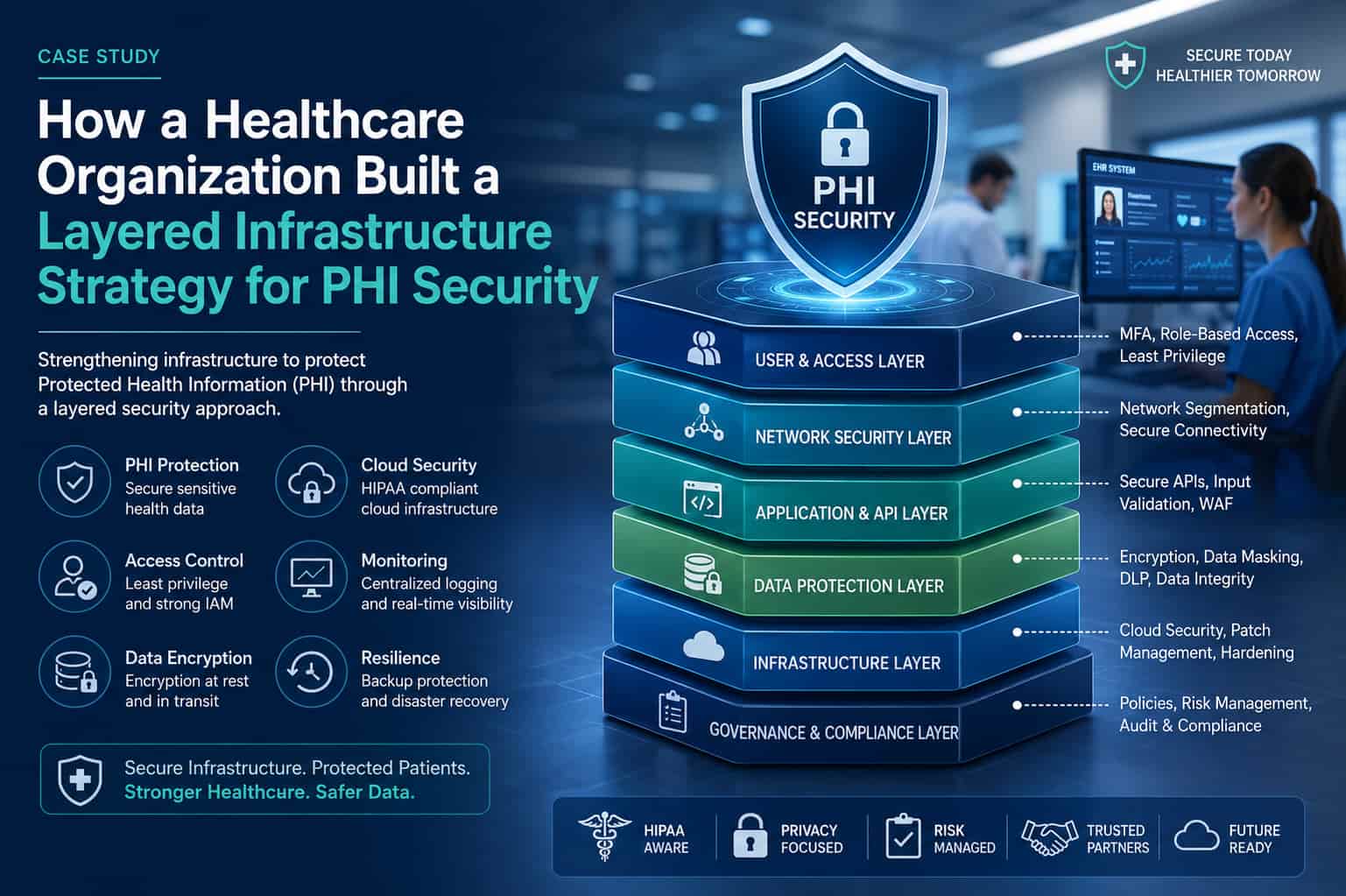
The first stage involved assessing the existing healthcare infrastructure and identifying gaps, dependencies, and areas requiring stronger controls. The assessment covered several areas.
Identity and Access Management
The organization reviewed user accounts, privileged accounts, roles, authentication methods, and access permissions to determine whether users had appropriate access to systems containing sensitive information.
Data Protection
The team evaluated how PHI was stored and transmitted, including encryption at rest and in transit, storage security, and key management practices.
Network Security
Network architecture was reviewed to identify opportunities for segmentation, firewall controls, secure connectivity, and improved traffic management.
Application and API Security
The assessment examined how healthcare applications exchanged information and whether APIs had appropriate authentication, authorization, monitoring, and access controls.
Monitoring and Auditability
The organization reviewed logging practices across cloud, application, network, and infrastructure environments to determine whether security events could be identified and investigated effectively.
Backup and Disaster Recovery
Backup processes and recovery procedures were evaluated to determine whether critical systems and data could be restored following operational disruption or security incidents.
Cloud Infrastructure
Cloud configurations were reviewed with particular attention to identity, storage, network controls, logging, encryption, and the responsibilities shared between the organization and its cloud providers.
Governance and Vendors
The organization also examined security policies, risk assessments, workforce controls, vendor relationships, and contractual requirements relevant to PHI handling.
3. Infrastructure Modernisation Approach
Instead of relying on a single security layer, the organization adopted a layered infrastructure strategy. The objective was to establish multiple complementary safeguards so that identity, devices, networks, applications, data, and infrastructure were protected through appropriate controls. The modernization strategy included centralized identity management, stronger authentication, role-based access, network segmentation, secure API integration, improved monitoring, protected backups, and more structured cloud security controls. The organization also prioritized modernization according to business and security risk. Critical systems handling sensitive information received greater attention, while less critical components were addressed through subsequent phases. This approach allowed the organization to modernize its environment without treating infrastructure transformation as a single large-scale implementation.
4. Key Technical Measures
Multi-Factor Authentication
Multi-factor authentication (MFA) was introduced or strengthened for appropriate users and systems, particularly where access involved sensitive applications or privileged functions.
Role-Based and Least-Privilege Access
Access policies were redesigned around job responsibilities. Least privilege access helped limit unnecessary permissions and reduce broad access to sensitive systems. Privileged accounts received additional controls and monitoring.
Encryption
Encryption at rest and in transit was incorporated into the organization's healthcare data protection strategy. The organization also considered appropriate key management processes rather than treating encryption alone as sufficient protection.
Network Segmentation
Critical systems were separated from general network environments using appropriate segmentation and traffic controls. This helped create clearer boundaries around sensitive workloads and reduced unnecessary communication between systems.
Secure APIs
APIs connecting healthcare applications and third-party systems were reviewed and secured using appropriate authentication, authorization, encryption, monitoring, and access policies. This was particularly important because integrations could create additional pathways for exchanging PHI.
Centralized Logging and Monitoring
The organization improved visibility by bringing relevant security and infrastructure logs together for monitoring and investigation. Alerts and monitoring processes were established around authentication activity, privileged access, unusual behavior, and other relevant security events.
Backup and Disaster Recovery
Backup protection was strengthened, while recovery procedures were reviewed and tested. The goal was to support availability and resilience while protecting backup environments from unauthorized access or accidental exposure.
Cloud Security Controls
For cloud workloads, the organization reviewed identity permissions, network configurations, storage controls, encryption, logging, and other security settings. The organization also clarified responsibilities between internal teams and cloud providers.
5. Vendor and Governance Considerations
Technical safeguards were only one component of the broader strategy. The organization strengthened documentation around security controls, policies, risk assessments, incident response, workforce responsibilities, and vendor management. Third-party providers were evaluated based on their role in processing, storing, or transmitting PHI. Where applicable, the organization also reviewed Business Associate Agreements (BAAs) and related contractual requirements. This governance layer helped ensure that infrastructure decisions were aligned with operational responsibilities rather than relying solely on technical controls.
Importantly, the organization recognized that HIPAA compliant infrastructure does not mean that a technology environment automatically makes an organization HIPAA compliant. HIPAA compliance involves technical safeguards as well as administrative, organizational, workforce, risk-management, and other responsibilities.
6. Expected Business Value
The initiative was expected to provide several areas of business and operational value. A layered infrastructure model could provide:
- Stronger visibility across infrastructure and applications
- More consistent access control
- Improved protection of sensitive healthcare data
- Better monitoring and auditability
- Greater infrastructure resilience
- More structured third-party risk management
- A stronger foundation for healthcare application modernization
- Greater consistency across cloud and on-premises environments
The organization did not treat these improvements as guarantees of compliance or security. Instead, they represented a stronger technical foundation that could support ongoing security and compliance programs.
Problem → Approach → Solution → Expected Business Value
Problem: Fragmented access controls, aging infrastructure, complex integrations, inconsistent monitoring, and growing cloud and remote-access requirements created challenges for protecting PHI.
Approach: Assess the environment across identity, data, networks, applications, APIs, cloud infrastructure, monitoring, backups, vendors, and governance.
Solution: Implement layered controls including MFA, role-based access, least privilege, encryption, segmentation, secure APIs, centralized monitoring, protected backups, disaster recovery, and cloud security practices.
Expected Business Value: A more consistent, visible, resilient, and security-focused infrastructure foundation capable of supporting future healthcare technology modernization.
Key Takeaways for Healthcare Organizations
Protecting PHI requires organizations to think beyond individual security tools. A strong HIPAA compliant infrastructure strategy should consider how identity, applications, networks, cloud environments, data, integrations, vendors, and governance work together. Healthcare organizations should also avoid treating HIPAA as a technology checkbox. Infrastructure controls can support HIPAA-related safeguards, but organizational policies, risk assessments, workforce practices, contracts, procedures, and ongoing compliance responsibilities remain essential. A phased infrastructure modernization strategy can help organizations address their highest-priority risks while creating a more resilient foundation for future digital healthcare initiatives.
Build a Secure Foundation for Healthcare IT Modernization
Healthcare organizations need infrastructure that can support innovation without overlooking the security and operational requirements associated with sensitive health information.
Have a Technical Challenge Worth Discussing?
Our practice leads are happy to talk through your specific situation, no sales pitch required.