How an Enterprise Built an Omnichannel Commerce Strategy With Headless Architecture
1. Business Challenge
A growing enterprise ecommerce business had expanded beyond a traditional online storefront. Its digital ecosystem included a primary website, mobile experience, B2B portal, regional storefronts, personalized content, and several third-party services. However, the company's tightly coupled ecommerce platform was becoming a constraint. Frontend teams often depended on backend development teams to make experience changes. Updates that appeared simple from a customer perspective could require changes across multiple connected systems. Different digital channels also had different requirements, making it difficult to maintain a consistent experience.
The company faced several challenges:
- Slow frontend release cycles
- Complex third-party integrations
- Limited frontend customization
- Increasing dependency between development teams
- Difficulty maintaining consistent experiences across channels
- Different regional and B2B requirements
- Growing personalization needs
- Increasing complexity as new digital touchpoints were introduced
The business needed to improve its omnichannel commerce capabilities without continuously increasing the complexity of its existing architecture. Rather than immediately replacing every component, the organization began evaluating whether a headless commerce platform could provide a more flexible foundation.
2. Architecture Assessment
The first step was to understand the company's existing ecommerce ecosystem and identify where its architecture was creating business constraints. The assessment covered the ecommerce platform, frontend applications, product information, content management, search, payments, customer data, analytics, inventory, order management, and enterprise integrations. The organization identified several requirements for its future digital commerce platform. The architecture needed to support multiple customer-facing experiences while allowing those experiences to evolve independently. It also needed to integrate with existing enterprise systems without creating additional point-to-point dependencies.
Another priority was regional flexibility. Different markets required variations in content, product availability, pricing, promotions, and customer experiences. The architecture therefore needed to support localization without forcing every storefront to operate as an entirely separate commerce environment. The business also wanted its B2B portal and mobile experience to access appropriate commerce capabilities without duplicating core commerce logic. These requirements made a decoupled architecture worth evaluating.
3. Headless Commerce Strategy
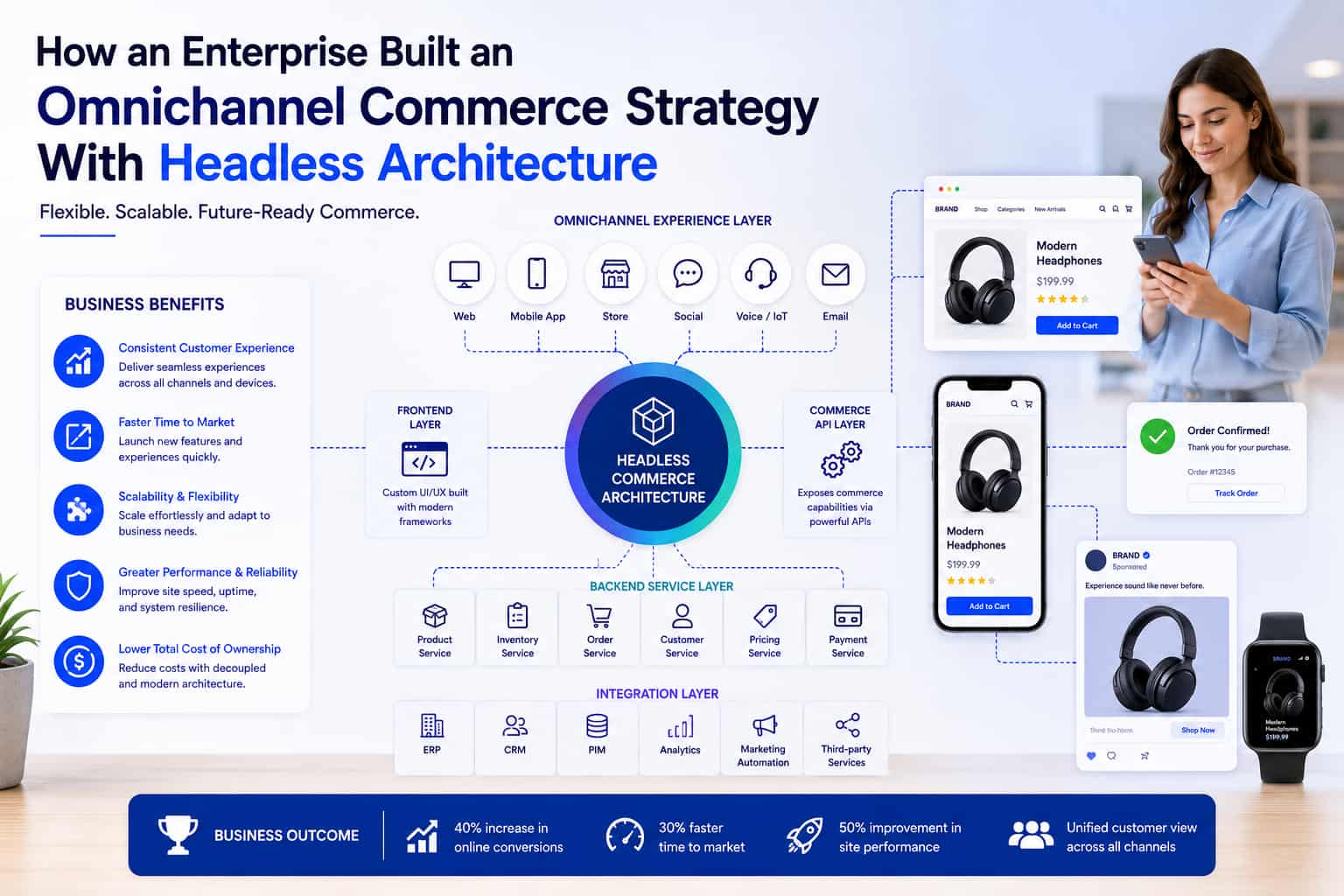
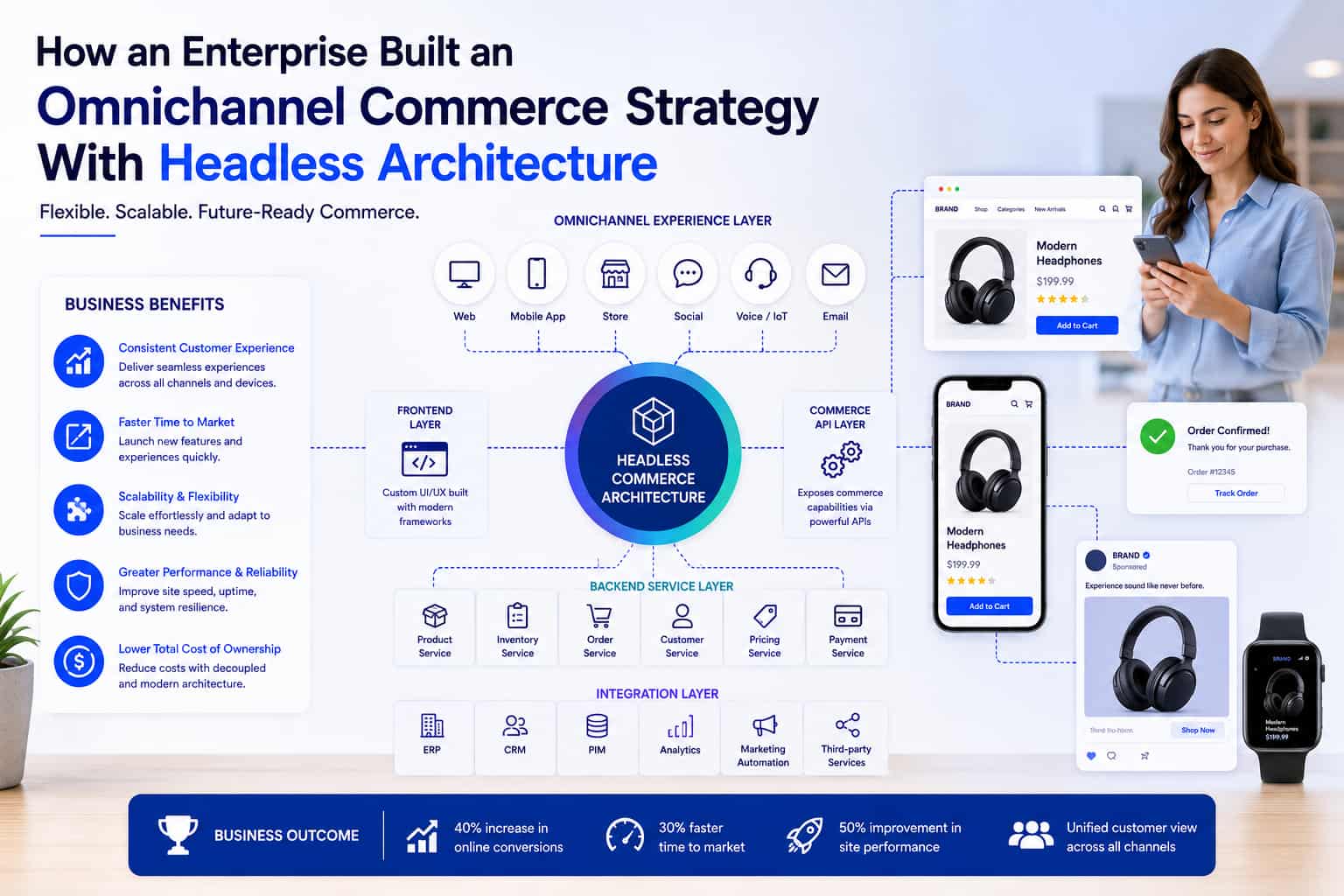
The organization adopted a headless commerce architecture in which the frontend presentation layer was separated from the underlying commerce capabilities. Instead of having one tightly connected frontend determine how commerce services were delivered, backend capabilities could be exposed through APIs and consumed by different digital experiences. This created a more flexible architecture. The website could have its own customer experience, while mobile applications, B2B portals, and regional storefronts could use the same underlying commerce capabilities where appropriate.
The strategy also allowed frontend teams to work with technologies suited to their specific experience requirements without making the entire commerce platform dependent on a single presentation layer. The company considered composable commerce principles as part of its longer-term architecture strategy, particularly for capabilities such as content, search, personalization, and customer experience. However, the organization focused first on solving its immediate business and integration challenges rather than adopting technology simply for architectural fashion.
4. Implementation Approach
The transformation was divided into manageable stages.
API-First Commerce Architecture
The enterprise established an API-driven approach for accessing core commerce capabilities. Relevant ecommerce APIs were used to connect frontend applications with functions such as product catalogs, customer accounts, carts, orders, pricing, inventory, and checkout. This helped separate presentation requirements from core commerce services.
CMS Integration
A flexible content management architecture allowed marketing teams to manage content independently from frontend development. This supported different campaigns, landing pages, regional experiences, and product-related content across channels.
Product Information Management
Product information was integrated with the commerce ecosystem so that appropriate product details could be consistently delivered to different customer experiences. This was particularly important for regional storefronts and B2B scenarios where product information and purchasing requirements could differ.
Search and Discovery
The architecture incorporated search capabilities that could support product discovery across different digital experiences. The organization also considered how search, product information, personalization, and customer context would work together.
Payments and Checkout
Payment capabilities were integrated through appropriate APIs and services while keeping checkout requirements aligned with the specific customer experience.
Customer Data and Analytics
Customer and behavioral information was connected with relevant systems to support personalization, analytics, and customer journey visibility.
Enterprise System Integration
The architecture was also designed to connect with existing ERP, CRM, inventory, fulfillment, marketing, and other business systems. Rather than allowing every frontend to connect independently to these systems, integration patterns were designed to reduce unnecessary complexity.
5. Supporting an Omnichannel Experience
One of the primary goals was to create a consistent commerce foundation across customer touchpoints. The website could provide a highly customized shopping experience while the mobile application could use the same underlying commerce services through APIs. The B2B portal could access relevant product, pricing, account, ordering, and customer capabilities while maintaining an experience designed specifically for business buyers. Regional storefronts could use shared commerce services while presenting localized content, products, pricing, and experiences where required.
This approach helped the organization move toward a more unified omnichannel commerce model. Importantly, consistency did not mean that every channel had to look or behave identically. The objective was to provide a connected commerce foundation while allowing each channel to deliver an experience appropriate to its users.
6. Expected Business Value
The expected business value centered on greater architectural flexibility rather than a guaranteed increase in sales or revenue.
The new approach could help the enterprise:
- Accelerate frontend development and experimentation
- Reduce dependencies between frontend and backend teams
- Reuse commerce capabilities across channels
- Simplify selected integrations
- Support multiple digital storefronts
- Improve consistency across customer touchpoints
- Provide greater flexibility for B2B and regional experiences
- Create a foundation for future ecommerce modernization
The organization also gained a clearer path for evolving individual components without necessarily redesigning the entire digital commerce environment. These benefits depend on implementation quality, integration design, development capabilities, governance, and ongoing platform management.
Traditional Architecture → Headless Approach → Expected Outcome
Traditional Architecture: A tightly coupled ecommerce platform connected frontend experiences closely with backend commerce functionality, resulting in slower releases, integration dependencies, and limited flexibility across channels.
Headless Approach: The enterprise separated frontend experiences from commerce services and introduced API-first integration across the website, mobile experience, B2B portal, regional storefronts, CMS, search, payments, customer data, and enterprise systems.
Expected Outcome: A more flexible modern ecommerce architecture capable of supporting multiple customer touchpoints while allowing frontend experiences and backend commerce capabilities to evolve more independently.
Key Takeaways
This case demonstrates why enterprises should evaluate headless architecture based on business requirements rather than technology trends. A headless commerce platform can be valuable when an organization needs multiple digital experiences, complex integrations, greater frontend flexibility, or a stronger omnichannel strategy. However, headless architecture also introduces additional development, integration, infrastructure, testing, and maintenance responsibilities.
The right approach is therefore to assess the existing ecommerce environment, identify specific limitations, define the required customer experiences, and create a phased architecture roadmap. For enterprises with complex digital commerce requirements, headless can provide a foundation for building experiences that evolve without tightly coupling every frontend change to the underlying commerce platform.
Modernize Your Enterprise Commerce Architecture
Building an effective omnichannel strategy requires more than launching additional digital channels. The underlying architecture must allow those channels to share appropriate commerce capabilities while remaining flexible enough to evolve. DashMindsIQ helps enterprises design scalable commerce architectures that support connected customer experiences, flexible integrations, and long-term digital commerce growth.
Have a Technical Challenge Worth Discussing?
Our practice leads are happy to talk through your specific situation, no sales pitch required.