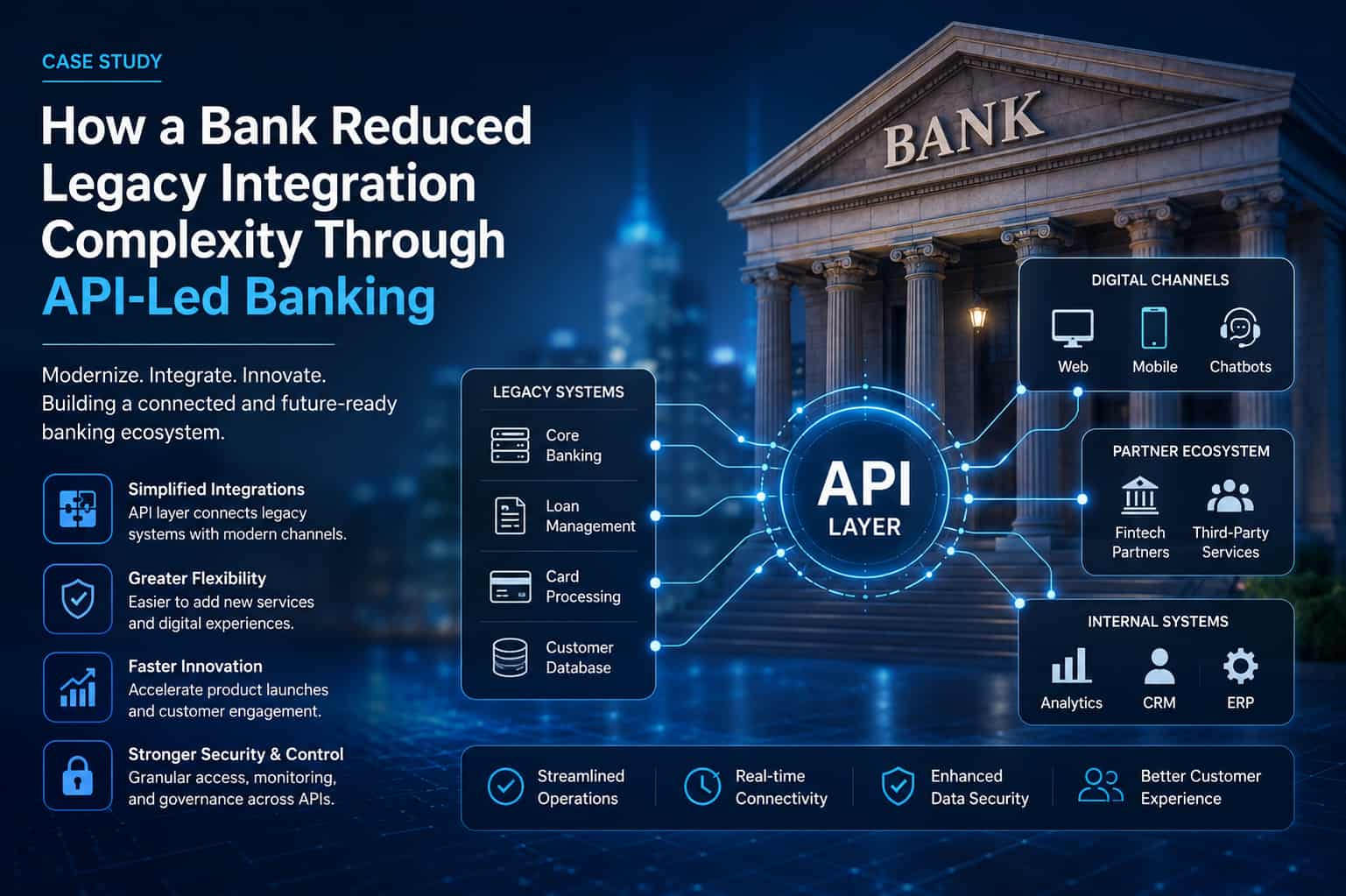
How a Bank Reduced Legacy Integration Complexity Through API-Led Banking
1. Business Challenge
A growing financial institution was operating on a collection of legacy banking systems that had evolved over many years. While these systems continued to support critical banking functions, their architecture was making it increasingly difficult for the bank to introduce new digital services and integrate modern applications. The bank's technology teams were dealing with fragmented customer data, limited API capabilities, batch-oriented processes, and tightly coupled legacy dependencies. Connecting a new digital banking application to core systems often required custom interfaces and coordination across multiple technology teams.
These constraints affected the bank's ability to respond quickly to changing customer and business requirements. New digital initiatives could require significant integration effort, while existing interfaces were increasingly difficult to maintain. The bank recognized that continuing to add point-to-point integrations would increase technical complexity. At the same time, a complete replacement of the core banking environment represented a significant transformation involving data migration, operational risk, regulatory considerations, and extensive testing.
The organization therefore began exploring core banking modernisation through a more controlled, API-led approach.
2. Transformation Requirements
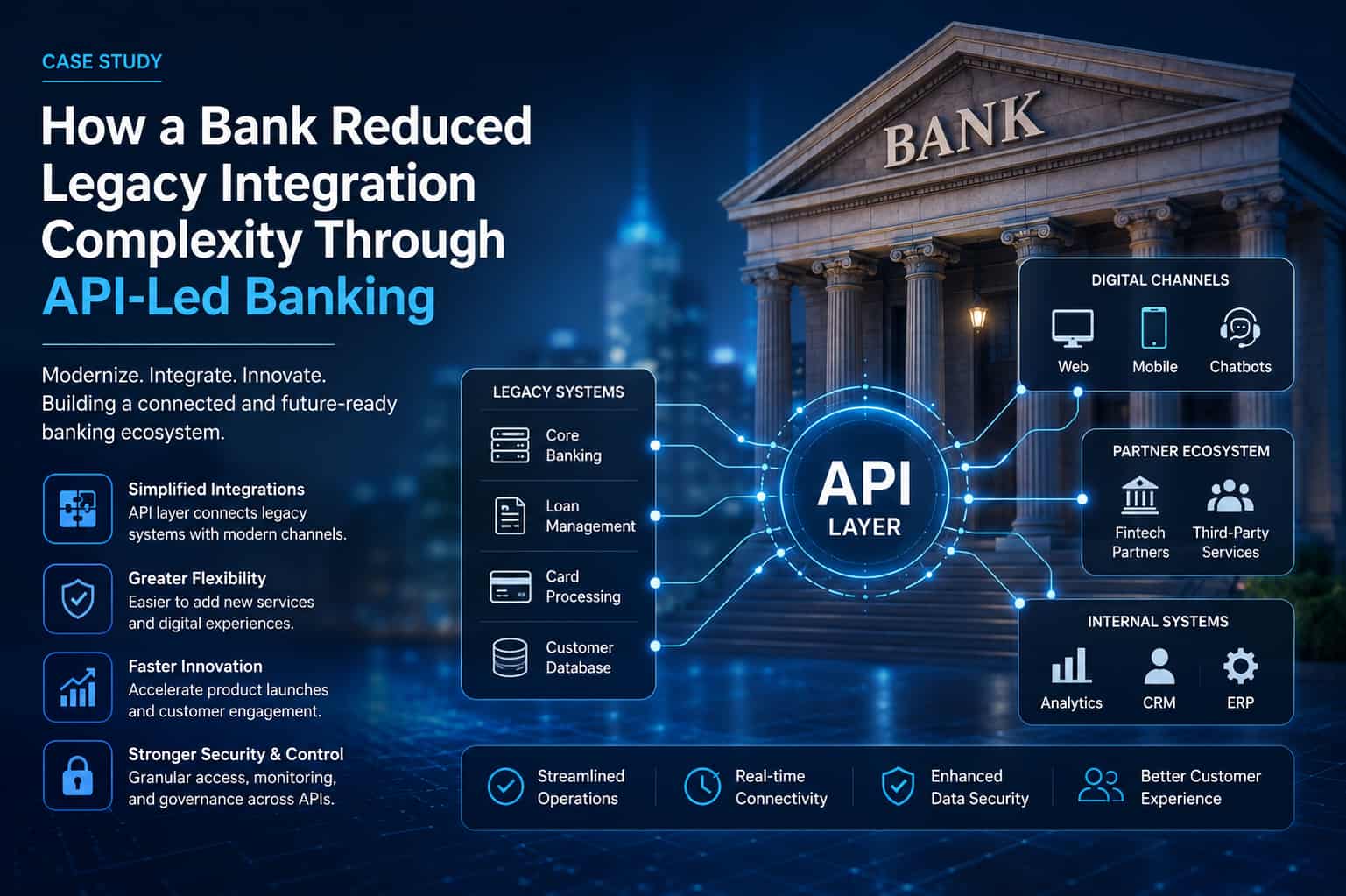
The bank needed a modernization strategy that improved integration capabilities without putting critical banking operations at unnecessary risk.
The transformation needed to support several objectives:
- Connect modern digital applications with existing core systems
- Reduce dependency on point-to-point legacy integrations
- Improve access to relevant banking services and data
- Support digital banking transformation initiatives
- Create a foundation for future modernization
- Maintain transaction processing and customer services during the transition
- Address security, governance, and regulatory requirements
- Avoid an immediate “big bang” replacement of the core platform
The bank's leadership therefore viewed modernization as a gradual transformation rather than a single technology migration.
3. Modernisation Strategy
The bank adopted a phased API-led banking strategy designed to create a layer between legacy systems and newer applications. Instead of allowing every digital application to connect directly to individual legacy systems, the bank introduced standardized APIs around selected core capabilities. These APIs could provide controlled access to services such as customer information, account information, transaction-related functions, and other appropriate banking capabilities. The strategy combined several modernization techniques.
API-Led Modernisation
APIs created reusable integration points between legacy capabilities and modern applications. This reduced the need to create separate connections for every new digital initiative.
Incremental Transformation
The bank prioritized individual capabilities rather than attempting to modernize the entire core environment simultaneously.
Cloud-Enabled Architecture
Where appropriate, modern integration and application components could be deployed using cloud-enabled infrastructure, while critical legacy workloads continued operating within their existing environments.
Selective Replacement
As individual legacy capabilities reached modernization priorities, they could be replaced or redesigned without requiring the entire core banking platform to be replaced at once. This approach created a gradual path toward a more flexible modern core banking architecture.
4. Data and Integration Approach
Data was one of the most important considerations in the transformation. The bank needed to understand where customer and transaction information was stored, how different systems depended on that information, and how data moved between applications.
Before implementing new integrations, the technology team mapped:
- Customer and account data
- Transaction flows
- Existing interfaces
- Legacy system dependencies
- Digital channel requirements
- API consumers
- Data ownership
- Security requirements
- Regulatory and reporting dependencies
Data reconciliation was also important. When information moved between legacy and modern services, the bank needed appropriate controls to verify that data remained accurate and consistent. Security was incorporated into the API strategy through authentication, authorization, access controls, encryption, monitoring, and appropriate policy enforcement. The bank also established testing processes covering API functionality, integration behavior, transaction processing, data accuracy, security, performance, and failure scenarios. Rather than treating integration as a separate technical activity, the bank incorporated it into its broader banking modernization strategy.
5. Implementation
The modernization program began with an assessment of the existing technology environment.
Stage 1: Architecture Assessment
The bank mapped its legacy applications, integrations, data stores, interfaces, and critical dependencies.
Stage 2: Capability Prioritisation
Technology and business teams identified capabilities where improved integration could provide the greatest strategic value without unnecessarily increasing operational risk.
Stage 3: API Layer Development
APIs were developed around selected legacy capabilities, providing controlled interfaces for approved applications and services.
Stage 4: Digital Integration
New or existing digital channels could then consume these APIs instead of creating additional direct connections to individual legacy systems.
Stage 5: Monitoring and Governance
API usage, access, performance, errors, and security events were monitored. Governance processes were established to manage API versions, access policies, documentation, and lifecycle management.
Stage 6: Progressive Modernisation
With integration complexity better controlled, the bank could gradually evaluate which legacy capabilities should remain, be modernized, or eventually be replaced. This created a practical path toward broader core banking transformation without requiring an immediate full-platform migration.
6. Expected Business Value
The expected value of the initiative centered on creating a more manageable and adaptable integration environment.
The API-led approach could help the bank:
- Reduce the growth of point-to-point integrations
- Improve connectivity between legacy and modern applications
- Support digital banking initiatives more efficiently
- Reuse integration capabilities across multiple channels
- Create clearer separation between core services and customer-facing applications
- Establish a foundation for future modernization
- Reduce dependency on tightly coupled legacy interfaces
The transformation did not depend on assuming that modernization would automatically reduce costs or eliminate legacy technology. Instead, the goal was to create greater architectural flexibility while allowing the bank to modernize capabilities progressively.
Before → Approach → After
Before: Legacy banking systems, fragmented data, tightly coupled interfaces, limited API capabilities, and growing integration complexity made digital transformation more difficult. Approach: The bank introduced API-led banking, incremental modernization, cloud-enabled components where appropriate, stronger integration governance, and selective modernization of legacy capabilities. After: The bank established a more structured integration layer that could connect modern applications with existing banking systems while creating a controlled foundation for continued core banking modernisation.
Key Takeaways
his case demonstrates that banks do not necessarily need to choose between keeping legacy systems unchanged and replacing the entire core immediately. A phased core banking modernization strategy can provide an intermediate path. API-led integration can help expose selected legacy capabilities to modern applications while reducing the need for additional point-to-point connections. However, APIs alone do not constitute modernization. Successful transformation also requires architecture planning, data governance, security, testing, operational controls, and a clear roadmap for progressively addressing legacy dependencies. For financial institutions, the most effective approach is one that aligns technology modernization with business priorities while carefully managing operational and regulatory requirements.
Build a More Flexible Banking Technology Foundation
Legacy systems can remain important to banking operations even when they begin limiting innovation. A carefully planned API-led banking strategy can help financial institutions connect existing capabilities with modern digital platforms while creating a path toward broader transformation. DashMindsIQ helps financial institutions modernize legacy environments through scalable, API-driven approaches that support integration, flexibility, and digital transformation.
Have a Technical Challenge Worth Discussing?
Our practice leads are happy to talk through your specific situation, no sales pitch required.