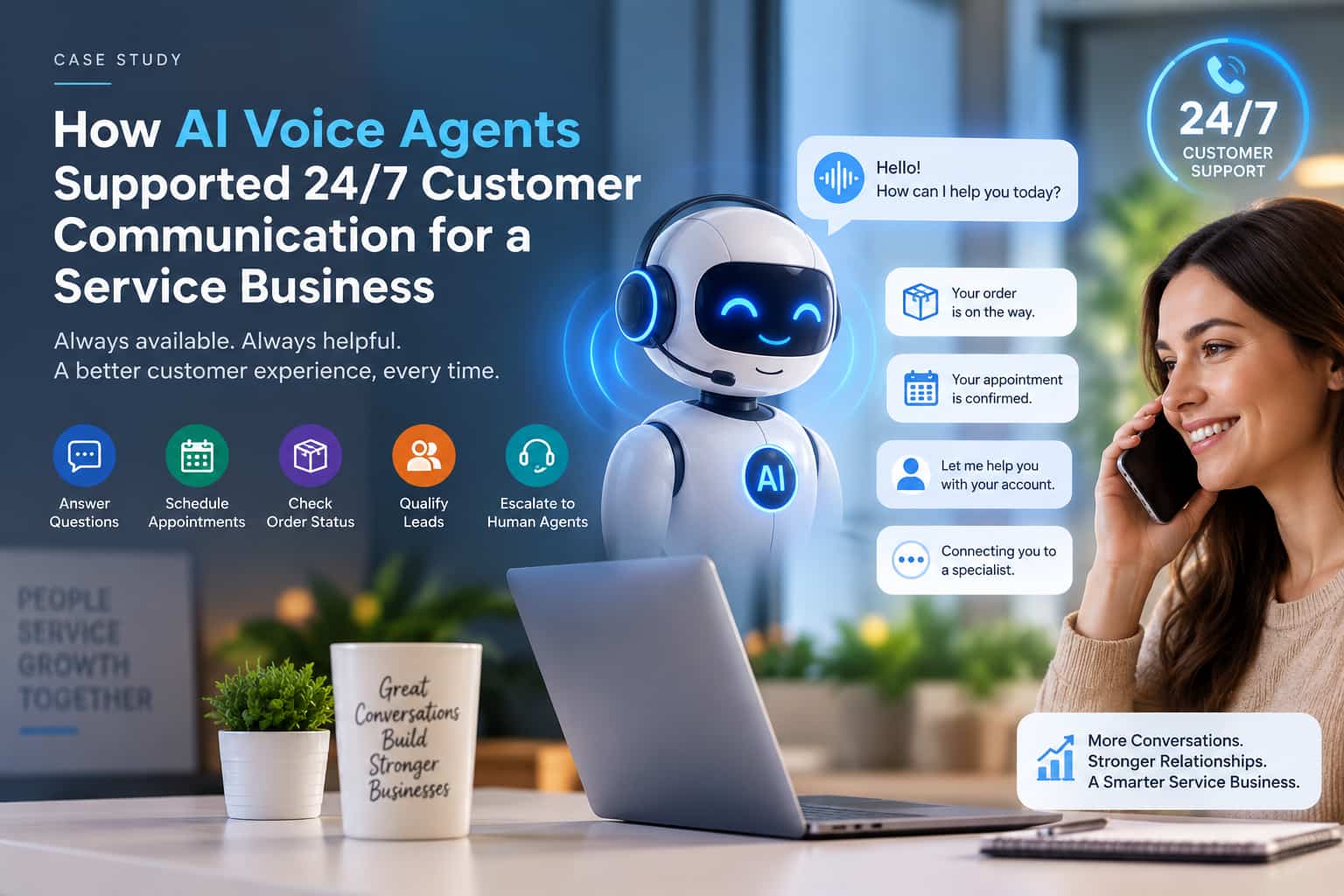
How AI Voice Agents Supported 24/7 Customer Communication for a Service Business
For service businesses, customer communication does not always fit within standard working hours. Customers may need appointment information, order updates, account assistance, or answers to routine questions outside the hours when human support teams are available. A growing service business faced this challenge as call volumes increased. Its customer service team was spending substantial time handling repetitive conversations, while customers experienced delays during busy periods and had limited support after hours.
The business explored AI voice agents for business as a way to extend customer communication, automate suitable routine interactions, and allow human agents to focus on conversations that required judgment or personal attention.
This representative case study demonstrates how a structured voice automation strategy could address these challenges without attempting to replace human customer service entirely.
1. Business Challenge
The business had built a growing customer base, resulting in a steady increase in inbound calls and follow-up requirements.
Many conversations were repetitive. Customers frequently called to:
- Check order or service status
- Request or change appointments
- Ask basic account questions
- Make initial service inquiries
- Follow up on previous requests
- Obtain information about available services
Although each interaction was relatively straightforward, the volume created an operational burden. During peak periods, customer service representatives had to manage multiple calls while responding to follow-up requests and updating customer records. This could contribute to longer wait times and inconsistent follow-up.
The business also had limited after-hours coverage. Customers who contacted the company outside operating hours might need to wait until the next business day for assistance. The organization therefore needed a way to provide more consistent customer communication without removing human involvement from complex interactions.
2. Existing Customer Communication Environment
The company was primarily using a traditional IVR system alongside manual customer service processes. The IVR provided basic menu-based routing, allowing callers to select options such as sales, billing, or support. However, customers had to navigate predefined menu structures rather than simply explaining what they needed. The manual process also created challenges around information sharing. Customer information was stored within business systems, while phone interactions were handled separately. This made it difficult to create a seamless connection between conversations, customer records, appointments, and follow-up activities. The business recognized that simply adding more IVR menus would not address the underlying problem. It needed a more conversational approach that could understand customer intent and interact with existing business systems.
3. AI Voice Agent Strategy
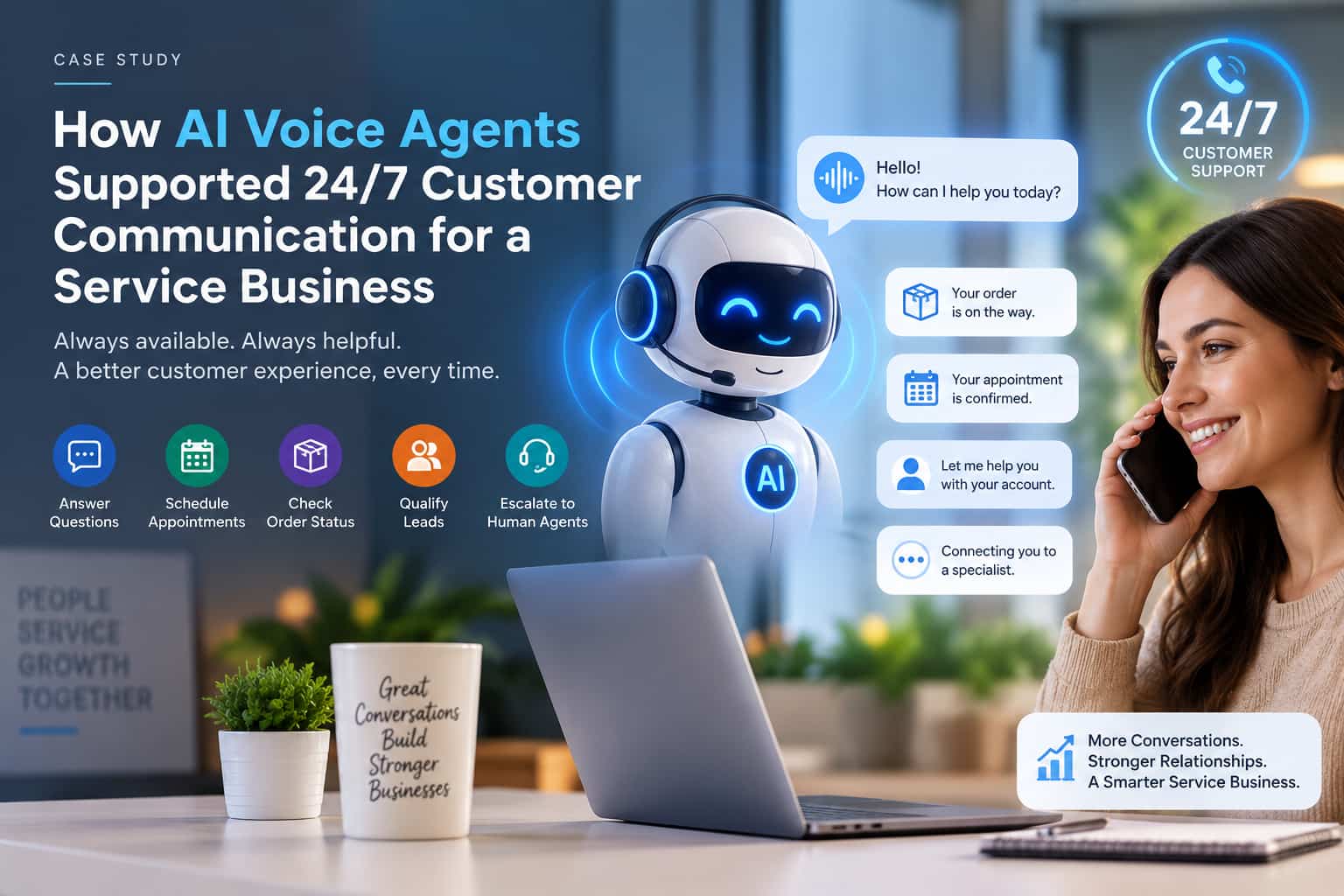
The organization evaluated an AI voice agent solution focused on specific, well-defined customer workflows. Rather than attempting to automate every type of conversation, the initial strategy concentrated on suitable repetitive interactions. The proposed solution used conversational AI to understand natural-language requests and identify the caller's intent.
For example, instead of navigating several menu options, a customer could say:
“I want to check the status of my service appointment.”
The intelligent voice agent could identify the request, securely retrieve the relevant information through an authorized integration, and provide an appropriate response.
The initial use cases included:
Appointment Management
The voice agent could help customers request available appointment times, confirm appointments, or handle predefined scheduling requests through integration with the company's scheduling system.
Status Updates
For suitable requests, the agent could retrieve order or service information and communicate the current status.
Lead Qualification
For new inquiries, the AI system could ask predefined qualification questions and capture relevant information before passing suitable leads to the sales team.
Basic Account Assistance
The agent could handle selected account-related questions after appropriate authentication and transfer sensitive or complex requests to human representatives. The agent could handle selected account-related questions after appropriate authentication and transfer sensitive or complex requests to human representatives.
Follow-Ups
The business could use automated calling for appropriate follow-up workflows, such as confirming appointments or reconnecting with customers after an inquiry.
4. Implementation Approach
The company approached implementation in phases rather than deploying voice automation across every customer interaction immediately.
Conversational Workflow Design
Each automated workflow was mapped from beginning to end, including expected customer responses, possible exceptions, and escalation points.
CRM and API Integration
The voice solution was connected to relevant business systems through APIs so that appropriate information could be accessed and recorded within existing workflows. This helped connect voice interactions with customer records rather than creating another isolated communication channel.
Authentication and Data Privacy
Because customer conversations could involve sensitive information, appropriate authentication and data-handling controls were considered. The organization also established rules around what information the AI agent could access and communicate.
Human Escalation
A critical part of the strategy was determining when automation should stop. Complex complaints, unusual requests, sensitive issues, or conversations requiring human judgment were routed to customer service representatives.
Monitoring and Testing
Before expanding the solution, the organization tested speech recognition, response quality, call routing, integration reliability, latency, and escalation behavior. Conversation monitoring also helped identify areas where workflows needed improvement.
5. Business Impact
The expected value of the initiative was primarily operational rather than simply technological. By automating appropriate repetitive interactions, the organization could potentially reduce the volume of routine work handled manually by customer service teams. The extended availability of AI-powered customer support also created an opportunity to provide basic assistance outside traditional business hours.
Other expected benefits included:
- More consistent handling of routine inquiries
- Improved availability for customers
- Better lead follow-up processes
- Reduced dependence on manual calling for suitable workflows
- Greater connection between voice interactions and CRM processes
- More time for human agents to focus on complex customer needs
These outcomes are illustrative and depend on factors such as workflow design, call volume, integration quality, customer adoption, and ongoing optimization.
Before → Approach → After
Before: High-volume repetitive calls, traditional IVR, manual follow-ups, limited after-hours communication, and disconnected customer information. Approach: Introduce conversational voice AI solutions for defined workflows, integrate them with business systems, establish authentication and escalation rules, and maintain human oversight. After: A more structured customer communication model where routine conversations can be supported through automation while human teams remain responsible for complex and sensitive interactions.
6. Key Takeaways for Other Businesses
This case demonstrates that successful voice automation does not begin with technology. It begins by identifying the right business processes. Businesses considering AI voice agents for business should first determine which conversations are repetitive, predictable, high-volume, and suitable for automation. They should then establish clear boundaries around data access, authentication, human escalation, and monitoring. Most importantly, AI should complement customer service teams rather than be treated as a universal replacement for human interaction. A phased implementation allows organizations to test individual workflows, understand customer behavior, refine conversational experiences, and expand automation where it creates genuine value.
Build a Smarter Customer Communication Strategy
For service businesses dealing with growing call volumes, intelligent voice agents can provide a practical way to extend customer communication while reducing the burden of repetitive interactions. DashMindsIQ helps businesses use AI-powered voice solutions to automate suitable conversations, streamline customer interactions, and connect voice workflows with existing business systems.
The strongest results come from combining conversational AI with reliable business integrations, well-designed workflows, appropriate security controls, and human oversight.
Have a Technical Challenge Worth Discussing?
Our practice leads are happy to talk through your specific situation, no sales pitch required.