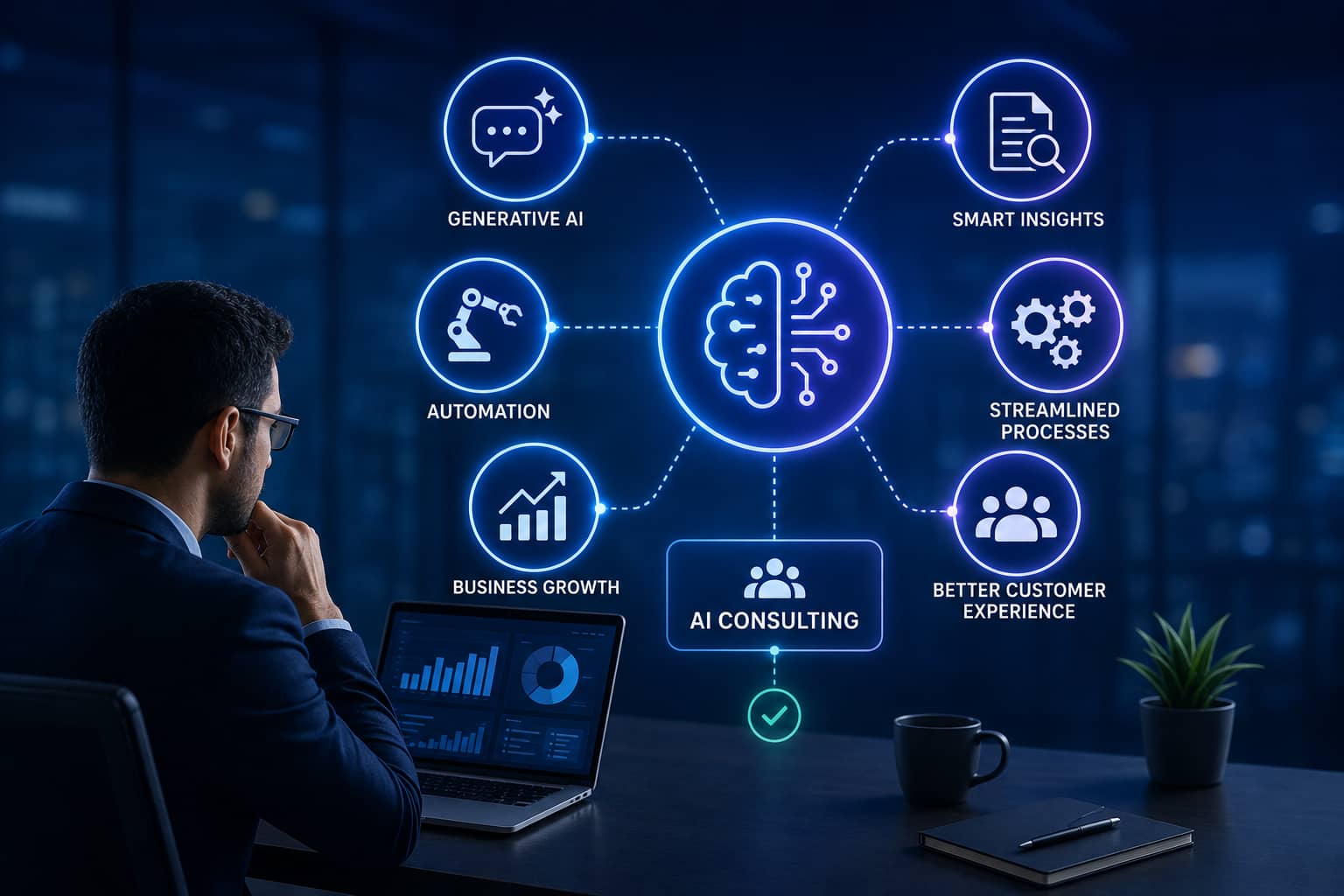
Artificial intelligence has moved from an experimental technology to an important business capability. Organizations are increasingly exploring generative AI, intelligent automation, machine learning, and AI-powered analytics to improve productivity, reduce operational effort, and deliver better customer experiences. DashMindsIQ helps organizations turn AI opportunities into practical, production-ready solutions, combining AI strategy, generative AI, machine learning, intelligent automation, and AI governance to support measurable business outcomes.
However, adopting AI successfully is not as simple as purchasing an AI tool. Businesses need to determine which use cases provide genuine value, prepare their data, address security concerns, and integrate AI into existing workflows.
This is where AI consulting can play an important role.
An experienced AI consulting partner helps organizations evaluate their readiness, identify practical AI opportunities, develop an implementation roadmap, and integrate AI solutions into business operations. With the right approach, businesses can use generative AI and automation to improve efficiency while creating a foundation for long-term digital transformation.
What Is AI Consulting?
AI consulting is a professional service that helps businesses plan, implement, and optimize artificial intelligence solutions according to their specific business objectives.
Rather than recommending technology simply because it is popular, an AI consultant evaluates the organization's processes, data, technology infrastructure, workforce, and strategic goals.
AI consulting services can include:
- AI readiness assessments
- AI strategy and roadmap development
- Generative AI consulting
- Machine learning consulting
- Intelligent process automation
- AI-powered application development
- Data and analytics consulting
- AI integration
- AI governance and security
- AI implementation and optimization
The objective is to connect AI capabilities with measurable business outcomes.
Why Businesses Are Adopting Generative AI and Automation
Generative AI has expanded the possibilities of artificial intelligence by enabling systems to generate text, images, code, summaries, recommendations, and other forms of content.
At the same time, intelligent automation allows businesses to automate repetitive tasks and workflows.
Together, these technologies can help organizations improve productivity across areas such as:
- Customer service
- Marketing
- Software development
- Human resources
- Finance
- Sales
- Operations
- Knowledge management
For example, a company could use generative AI to summarize customer interactions while automation routes the information to the appropriate team. This combination can reduce manual effort while helping employees work more efficiently.
How AI Consulting Helps Businesses Adopt Generative AI
1. Identifying the Right AI Use Cases
One of the biggest challenges businesses face is deciding where to use AI.
Not every process requires generative AI, and implementing AI without a clear business objective can result in unnecessary costs.
An AI consultant can analyze business processes and identify use cases based on factors such as:
- Potential business impact
- Implementation complexity
- Data availability
- Security requirements
- Expected return on investment
- Scalability
High-value use cases can then be prioritized for implementation.
2. Developing a Generative AI Strategy
A structured AI strategy helps organizations move beyond experimentation.
An AI consulting partner can create a roadmap covering:
- Current AI capabilities
- Business objectives
- Priority use cases
- Technology requirements
- Data requirements
- Security considerations
- Implementation priorities
- Performance measurement
This provides businesses with a practical path from AI experimentation to production-ready solutions.
3. Integrating Generative AI With Existing Systems
Businesses rarely operate using a single software platform. They may have CRM systems, ERP platforms, databases, cloud applications, customer portals, and internal tools.
Generative AI becomes more useful when it can work with these existing systems.
AI consultants can help organizations integrate AI capabilities through APIs, enterprise applications, data platforms, and automation workflows.
For example, an AI-powered customer service assistant could retrieve relevant information from an organization's approved knowledge base and provide responses while following defined business rules.
How AI Consulting Supports Intelligent Automation
Generative AI and automation can work together to create more intelligent business workflows.
Traditional automation generally follows predefined rules. AI-powered automation can analyze information, understand language, classify data, and make recommendations before triggering an appropriate workflow.
Automating Repetitive Business Tasks
AI consulting can help identify repetitive activities that consume employee time.
Potential applications include:
- Document classification
- Data extraction
- Invoice processing
- Email categorization
- Customer query routing
- Report generation
- Employee assistance
- Lead qualification
Automating these processes can reduce manual work and allow employees to focus on higher-value responsibilities.
Creating AI-Powered Customer Experiences
Businesses are also using AI to improve customer interactions.
AI-powered chatbots, virtual assistants, recommendation systems, and AI voice agents can provide faster support and more personalized experiences.
However, businesses need to design these systems carefully. An AI consulting partner can help determine when automation is appropriate and when human intervention should remain part of the process.
Current Trends in AI Consulting
The AI landscape continues to evolve quickly. Several developments are influencing how organizations approach AI adoption.
Generative AI Moving Into Enterprise Workflows
Businesses are increasingly looking beyond standalone AI tools and exploring ways to integrate generative AI into existing applications and workflows.
This shift focuses on using AI to solve specific business problems rather than treating it as a separate technology experiment.
AI Agents and Agentic Workflows
AI agents are becoming an important area of development. These systems can perform multiple steps toward a defined objective, interact with tools, and support more complex workflows.
Businesses are exploring agent-based solutions for research, customer service, software development, operations, and knowledge management.
Greater Focus on AI Governance
As AI adoption increases, organizations are paying greater attention to security, privacy, transparency, responsible AI, and regulatory requirements.
AI governance frameworks can help businesses establish rules around how AI systems are developed, deployed, monitored, and used.
AI and Data Becoming More Connected
The quality and accessibility of business data remain critical to successful AI implementation.
Organizations are therefore investing in data platforms, data governance, knowledge bases, and retrieval systems that can provide AI applications with reliable business information.
Benefits of Using AI Consulting Services
Faster AI Adoption
An experienced consulting partner can help businesses move from identifying opportunities to implementing practical solutions more efficiently.
Reduced Implementation Risk
Consultants can identify technical, operational, security, and data-related challenges before organizations make significant investments.
Better Return on Investment
By prioritizing high-value use cases, businesses can focus resources on AI initiatives that have a stronger connection to measurable outcomes.
Access to Specialized Expertise
AI projects can require expertise in machine learning, generative AI, data engineering, cloud infrastructure, automation, cybersecurity, and software development.
AI consulting provides access to specialized knowledge without requiring every business to build a large internal AI team immediately.
Improved Business Productivity
Automating repetitive processes and providing employees with AI-powered tools can help organizations improve productivity and reduce unnecessary manual work.
Challenges Businesses Need to Consider
AI adoption also presents challenges that should be addressed before implementation.
Data Quality
AI systems depend heavily on reliable and relevant data. Poor-quality, incomplete, or fragmented data can reduce the usefulness of AI applications.
Security and Privacy
Organizations must carefully manage sensitive business and customer information when implementing AI solutions.
Integration Complexity
Connecting AI systems with existing applications can require significant technical planning and development.
Employee Adoption
Employees may need training and guidance to use AI tools effectively. Successful implementation should focus on people and processes as well as technology.
Measuring Business Value
AI projects should have clear success metrics. Businesses need to determine whether an AI solution is actually improving productivity, reducing costs, increasing revenue, or improving customer satisfaction.
The Future of AI Consulting and Business Automation
The role of AI consulting is likely to expand as businesses move from basic AI experimentation toward broader enterprise adoption.
Future AI initiatives may increasingly combine:
- Generative AI
- AI agents
- Intelligent automation
- Machine learning
- Cloud computing
- Data analytics
- AI-powered applications
- Human-AI collaboration
Instead of implementing isolated AI tools, businesses will increasingly look for connected AI strategies that support multiple departments and business functions.
AI consultants can help organizations manage this transition by developing scalable architectures, establishing governance frameworks, identifying new opportunities, and continuously optimizing AI systems.
How Businesses Can Prepare for AI Adoption
Businesses looking to adopt generative AI and automation should take a structured approach.
Start With Business Problems
Identify areas where employees spend significant time on repetitive tasks or where better data-driven decisions could create measurable value.
Assess AI Readiness
Review existing data, technology infrastructure, security practices, and internal capabilities.
Prioritize Use Cases
Start with practical projects that offer clear value and manageable implementation requirements.
Establish Governance
Define policies for data protection, security, responsible AI use, access controls, and monitoring.
Measure Results
Track performance using clear business metrics and use those results to guide future AI investments.
Conclusion
Generative AI and intelligent automation are changing how businesses approach productivity, customer experience, and digital transformation. However, successful AI adoption requires more than access to advanced technology. DashMindsIQ helps organizations identify practical AI opportunities, develop focused strategies, integrate AI with existing systems, and move successful initiatives from concept to production. From AI consulting and generative AI development to intelligent automation, AI governance, and scalable implementation, DashMindsIQ focuses on aligning AI capabilities with measurable business outcomes. Contact DashMindsIQ to discuss your AI requirements and explore how AI consulting can help your organization improve efficiency, enhance customer experiences, and create new opportunities for growth.
Frequently Asked Questions
What is AI consulting?
AI consulting helps businesses identify, plan, implement, and optimize artificial intelligence solutions. Services may include AI strategy, generative AI consulting, machine learning, automation, integration, governance, and AI application development.
How can AI consulting help with generative AI adoption?
AI consultants can identify suitable generative AI use cases, evaluate data and technology readiness, recommend appropriate solutions, develop implementation roadmaps, and integrate AI into existing business workflows.
What is intelligent automation?
Intelligent automation combines technologies such as artificial intelligence, machine learning, and automation to perform business processes with less manual intervention. It can be used for tasks such as document processing, customer support, data classification, and workflow management.
Is generative AI suitable for every business?
Not necessarily. The value of generative AI depends on a company's processes, data, objectives, security requirements, and available resources. An AI readiness assessment can help determine where the technology can provide meaningful value.
What are the biggest challenges of AI adoption?
Common challenges include data quality, security and privacy concerns, integration complexity, employee adoption, governance, and difficulty measuring the business value of AI initiatives.
What is the future of AI consulting?
AI consulting is expected to increasingly focus on enterprise AI strategy, generative AI, AI agents, intelligent automation, AI governance, data readiness, and integrating AI into core business processes. The emphasis will increasingly shift from experimentation toward scalable and measurable business outcomes.