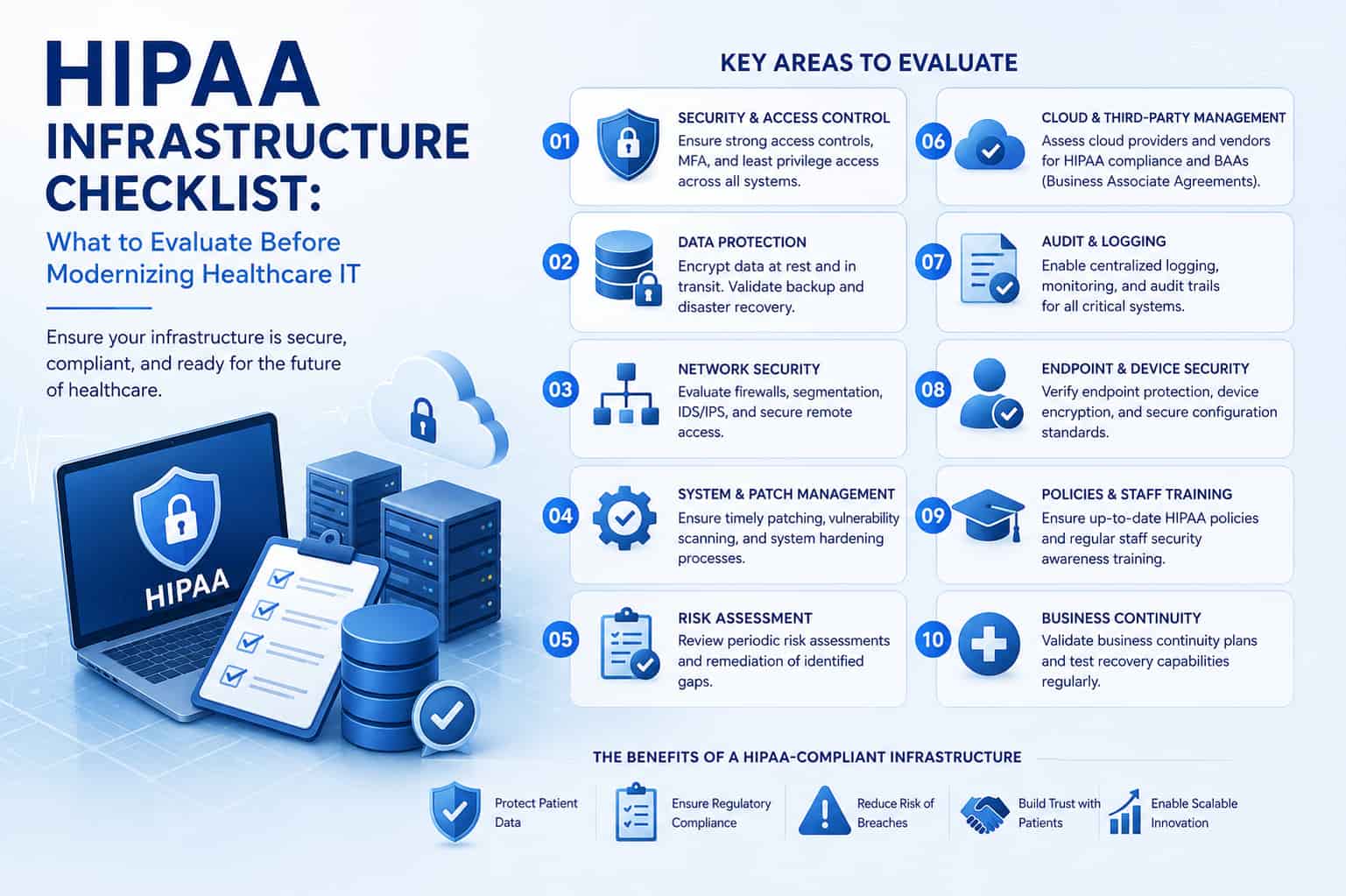
Modernizing healthcare IT infrastructure is no longer simply an infrastructure upgrade. Healthcare organizations need technology environments that can support digital applications, connected devices, cloud services, remote access, analytics, and interoperability while protecting sensitive patient information. For organizations handling Protected Health Information (PHI), infrastructure decisions also need to account for security, privacy, availability, access control, monitoring, and regulatory obligations.
A key point is that HIPAA compliant infrastructure is not created by purchasing a particular security product or choosing a specific hosting provider. Compliance involves a combination of technical safeguards, administrative processes, policies, risk management, workforce practices, and appropriate vendor relationships.
Before modernizing healthcare infrastructure, organizations should therefore evaluate the environment across multiple security and operational layers.
1. Identity and Access Management
Controlling who can access healthcare systems and PHI should be one of the first areas reviewed during an infrastructure modernization project.
A modern healthcare IT environment should consider:
- Role-based access controls
- Least-privilege access
- Multi-factor authentication (MFA)
- Privileged account management
- User provisioning and deprovisioning
- Regular access reviews
- Strong authentication policies
Not every employee needs access to every system or patient record. Access should be aligned with job responsibilities and business requirements.
Privileged accounts deserve particular attention because they can provide extensive access to infrastructure, applications, and sensitive information. Organizations should monitor these accounts closely and apply appropriate controls.
A strong identity and access strategy supports broader PHI security by reducing unnecessary access and improving accountability.
2. Data Protection and Encryption
Healthcare organizations need to understand where PHI is stored, processed, and transmitted across their environment. A HIPAA compliant infrastructure strategy should evaluate encryption for data at rest and in transit, along with appropriate key management practices.
Organizations should assess:
- Database and storage encryption
- Encryption during data transmission
- Key storage and rotation
- Secure backups
- Data retention requirements
- Access to encryption keys
- Data disposal processes
Encryption alone does not establish HIPAA compliance. It is one component of a broader healthcare data protection strategy. Organizations should also maintain visibility into where sensitive data exists across databases, applications, cloud storage, integrations, and backup environments.
3. Network Security
Healthcare environments often connect multiple systems, locations, applications, devices, employees, and external partners. Network security should therefore be designed to limit unnecessary connectivity and reduce the potential impact of a security incident.
Important areas to evaluate include:
- Network segmentation
- Firewalls
- Secure remote connectivity
- Traffic filtering
- Intrusion detection and prevention
- Network access controls
- Secure connections between healthcare facilities and cloud environments
Segmentation can help separate sensitive workloads from less critical systems. For example, healthcare applications containing PHI may require stronger controls than general corporate systems.
4. Application and API Security
Modern healthcare organizations increasingly depend on applications and APIs to exchange information between electronic health records, patient portals, billing systems, analytics platforms, mobile applications, and third-party services. These integrations can introduce additional security considerations.
Organizations should evaluate:
- API authentication and authorization
- Encryption
- Input validation
- Rate limiting
- Access controls
- API monitoring
- Secure software development practices
- Third-party integration security
An application can have strong infrastructure security and still expose sensitive information through an improperly secured API. For this reason, healthcare IT security needs to extend beyond servers and networks to the applications and interfaces connecting the environment.
5. Monitoring and Auditability
Security controls are most effective when organizations can determine what is happening within their environment. A modern infrastructure should provide appropriate visibility into user activity, privileged access, system events, authentication attempts, and other security-relevant activities.
Organizations should consider:
- Centralized logging
- Audit trails
- Security alerts
- Anomaly detection
- Authentication monitoring
- Privileged-user activity monitoring
- Log retention and protection
- Incident investigation capabilities
Monitoring can help security teams identify unusual behavior and investigate potential incidents. It also supports accountability by creating records of relevant activities within systems containing sensitive information.
6. Backup and Disaster Recovery
Protecting PHI is not only about preventing unauthorized access. Healthcare organizations also need to consider availability and resilience. A security incident, infrastructure failure, ransomware event, or natural disaster can affect access to critical healthcare applications.
Before modernization, organizations should evaluate:
- Backup frequency
- Backup security
- Backup isolation
- Recovery procedures
- Disaster recovery plans
- Recovery testing
- System dependencies
- Business continuity requirements
Backups should be protected from unauthorized access and potential compromise. More importantly, recovery procedures should be tested rather than existing only as documentation.
8. Governance, Risk, and Vendor Management
Technology controls are only one part of a HIPAA-focused security program. Organizations also need appropriate policies, procedures, workforce controls, risk assessments, incident response processes, and vendor management practices.
Before modernization, organizations should evaluate:
- Security and privacy policies
- Risk assessment processes
- Workforce training
- Incident response procedures
- Access review processes
- Vendor risk management
- Business Associate Agreements (BAAs)
- Documentation and accountability
This distinction is important: technical safeguards support compliance, but technology alone does not establish organizational HIPAA compliance.
What to Ask Before Choosing a HIPAA-Focused Infrastructure Provider
Selecting an infrastructure or technology provider requires more than comparing hosting specifications.
Healthcare organizations should ask potential providers:
What security controls are available?
Ask about encryption, identity management, network security, monitoring, access controls, backup protection, and other relevant safeguards.
What security documentation can you provide?
Understand what documentation is available to support security assessments, risk management, and internal governance.
How are security incidents handled?
Ask about incident detection, escalation, notification processes, response procedures, and communication responsibilities.
How are backups protected?
Understand backup frequency, isolation, encryption, retention, recovery procedures, and testing.
How is access managed?
Ask how provider personnel access customer environments, how privileged access is controlled, and whether access activity is monitored.
What monitoring capabilities are available?
Determine whether logs, audit trails, alerts, and security monitoring can support the organization's operational and compliance requirements.
Will you enter into an appropriate Business Associate Agreement?
Where applicable, organizations should understand the provider's contractual responsibilities regarding PHI and whether a BAA is available.
A Practical HIPAA Infrastructure Modernization Checklist
Before beginning a modernization project, healthcare organizations should be able to answer:
- Where is PHI stored and processed?
- Who can access it?
- Are privileged accounts adequately protected?
- Is sensitive data appropriately encrypted?
- Are networks properly segmented?
- Are applications and APIs securely integrated?
- Can security teams monitor relevant activity?
- Are backups protected and recovery procedures tested?
- Are cloud responsibilities clearly understood?
- Are policies, risk assessments, and workforce controls established?
- Are third-party vendors appropriately evaluated?
- Are applicable Business Associate Agreements in place?
These questions can help organizations identify gaps before they become infrastructure or security problems.
FAQs
1. What is HIPAA compliant infrastructure?
HIPAA compliant infrastructure refers to a technology environment designed with appropriate safeguards for protecting PHI and supporting applicable HIPAA requirements. It involves infrastructure controls as well as organizational policies, processes, risk management, and vendor responsibilities.
2. Does using HIPAA compliant hosting guarantee HIPAA compliance?
No. HIPAA compliant hosting is only one component of a broader compliance program. Organizations remain responsible for their own configurations, access controls, policies, workforce practices, applications, and other applicable safeguards.
3. Is cloud infrastructure suitable for healthcare organizations?
Cloud infrastructure can be suitable for healthcare workloads when appropriately designed, configured, secured, and governed. Organizations need to understand both their responsibilities and the cloud provider's responsibilities.
4. What is most important when protecting PHI?
There is no single control that provides complete protection. Effective PHI security typically requires layered safeguards covering identity, access, encryption, networks, applications, monitoring, backups, governance, and incident response.
5. How should healthcare organizations begin modernizing their infrastructure?
A practical starting point is to assess the existing environment, identify where PHI flows and resides, evaluate security and operational gaps, define business requirements, and create a phased modernization roadmap.
Modernize Healthcare IT With Security at the Foundation
Healthcare infrastructure modernization should balance innovation with security, resilience, and operational requirements. Rather than treating HIPAA as a technology checklist, organizations should build HIPAA compliant infrastructure with security and governance integrated into the architecture from the beginning. DashMindsIQ can help healthcare organizations modernize their infrastructure while maintaining strong security, compliance, and operational resilience.
A well-planned modernization strategy can provide a stronger foundation for cloud adoption, healthcare applications, integrations, analytics, and digital services while supporting responsible healthcare data protection.
Planning to modernize your healthcare IT environment? Talk to DashMindsIQ about building secure, scalable, and compliance-focused healthcare infrastructure aligned with your technology and business requirements.