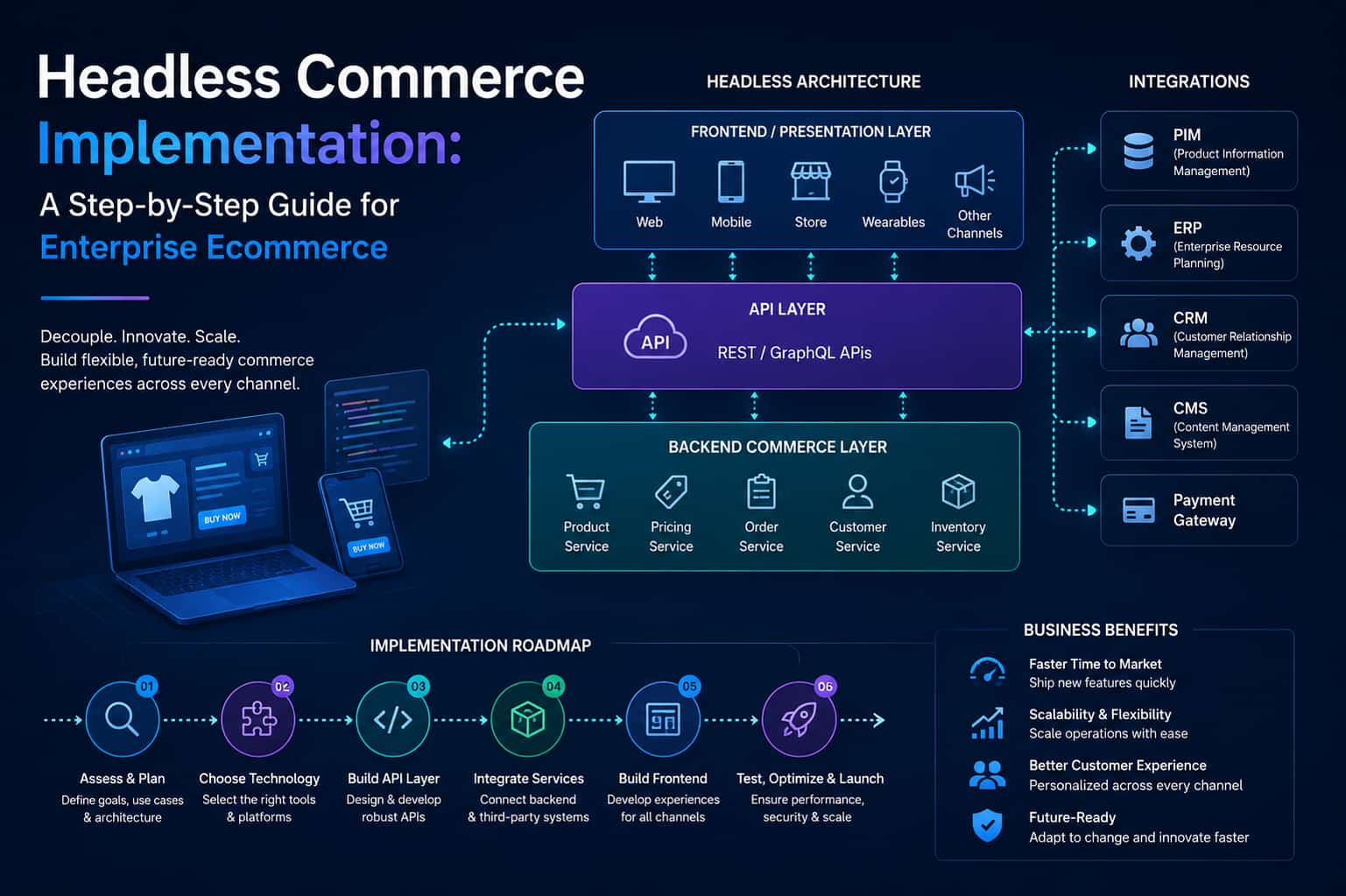
Enterprise ecommerce is becoming increasingly complex. Businesses may need to support websites, mobile applications, B2B portals, marketplaces, regional storefronts, social commerce, and other digital touchpoints—all while maintaining consistent product, customer, pricing, and order experiences. For some organizations, traditional ecommerce platforms can become restrictive as these requirements grow. Slow frontend changes, tightly coupled systems, difficult integrations, and limited flexibility can make it harder for digital teams to respond quickly.
This is where a headless commerce platform can become a strategic option. However, headless commerce is not automatically the right answer for every business. The decision should depend on the organization's complexity, digital ambitions, technical capabilities, and long-term architecture strategy.
Why Enterprises Consider Headless Commerce
Traditional ecommerce platforms often combine the presentation layer with backend commerce functionality. This can work well for businesses with relatively straightforward requirements. As an enterprise grows, however, several challenges can emerge. Frontend teams may depend heavily on backend development for relatively simple experience changes. Businesses operating across multiple regions may need different storefronts while maintaining centralized commerce capabilities. Mobile applications, B2B portals, marketplaces, and other channels can also introduce additional integration requirements.
Other common drivers include:
- Slow frontend development cycles
- Limited customization within traditional platforms
- Complex third-party integrations
- Multiple digital customer touchpoints
- Increasing personalization requirements
- Omnichannel commerce requirements
- Need for greater frontend technology flexibility
A headless ecommerce approach addresses these challenges by separating the customer-facing experience from the underlying commerce services.
Understanding Headless Commerce With a Simple Analogy
Think of an ecommerce business as a restaurant. In a traditional model, the kitchen, dining area, and service process are closely connected. Changing one part may affect the others. With headless commerce, the kitchen—the commerce engine—can operate independently from the dining experience—the frontend. The same kitchen can serve customers through a restaurant, takeaway counter, delivery service, or mobile ordering application. Similarly, a headless commerce platform allows the commerce backend to support multiple customer-facing experiences through APIs. This separation gives frontend teams greater freedom to design experiences without requiring the entire commerce system to change.
Traditional Commerce vs Headless Commerce vs Composable Commerce
These three approaches are related but not identical. Traditional commerce typically offers moderate frontend flexibility, limited backend independence, and platform-dependent integrations, with content management often built into the platform. Headless commerce provides greater frontend flexibility and backend independence through API-driven integrations, supporting flexible content management, scalability, and strong omnichannel capabilities, although it can involve medium to high operational complexity. Composable commerce takes modularity further, offering very high frontend flexibility, independent content management, highly modular integrations, and strong scalability and omnichannel capabilities, but it generally requires a more complex development and operational workflow.
Traditional ecommerce can be easier to deploy and operate when requirements are straightforward.
Headless commerce separates the frontend from the commerce backend, providing greater flexibility while retaining a centralized commerce engine.
Composable commerce goes further by allowing organizations to assemble different capabilities—such as commerce, search, CMS, personalization, and payments—from independent components.
The right architecture depends on the business rather than the technology label.
Step-by-Step Headless Commerce Implementation
Step 1: Define the Business Requirements
Before selecting a digital commerce platform, identify the problems the architecture needs to solve. Consider whether the business needs multiple storefronts, international experiences, B2B functionality, mobile applications, marketplace integrations, advanced personalization, or highly customized customer journeys. Headless should solve a defined business problem—not simply become a technology experiment.
Step 2: Assess the Existing Ecommerce Architecture
Review the current platform, integrations, databases, customer data, product information, content systems, payment services, search functionality, and analytics. Identify which components should remain and which need modernization. This assessment can also reveal whether the existing platform already provides sufficient flexibility, making a complete transition unnecessary.
Step 3: Design the API-First Architecture
APIs are fundamental to headless commerce. The architecture should define how the frontend communicates with commerce services such as:
- Product catalogs
- Pricing
- Cart and checkout
- Customer accounts
- Orders
- Inventory
- Promotions
- Payments
A well-designed API layer allows different customer-facing applications to access appropriate commerce capabilities without being tightly coupled to the backend.
Step 4: Select the CMS and Content Architecture
Enterprise ecommerce often requires more than product transactions. Marketing teams need to manage landing pages, editorial content, campaigns, product stories, guides, and localized experiences. A headless CMS can provide content independently from the frontend, allowing content teams and developers to work more efficiently.
Step 5: Plan Search, Product Information, and Customer Data
Search can significantly influence ecommerce usability. Enterprises should consider how search, recommendations, product information, inventory, customer profiles, and pricing will interact with the commerce platform. For international or B2B businesses, product information and customer-specific pricing can become particularly important architectural considerations.
Step 6: Build the Frontend Experience
Once the backend services and APIs are defined, development teams can select frontend frameworks and create the customer experience. This is one of the major attractions of headless architecture: organizations are not necessarily restricted to the presentation technology built into their ecommerce platform. The frontend can be optimized for websites, mobile applications, kiosks, portals, or other digital touchpoints.
Step 7: Integrate Payments, Analytics, and Enterprise Systems
The implementation should account for the wider technology ecosystem. Common integrations may include:
- Payment gateways
- ERP systems
- CRM platforms
- PIM systems
- Search services
- Marketing platforms
- Customer data platforms
- Analytics tools
- Shipping and fulfillment systems
Careful integration design is essential because enterprise headless environments can involve many independent services.
Step 8: Test, Launch, and Continuously Maintain
Testing should cover functionality, APIs, performance, security, checkout, integrations, mobile experiences, and failure scenarios. After launch, businesses also need to manage API changes, security updates, infrastructure, monitoring, frontend releases, and third-party dependencies. Headless commerce can provide flexibility, but that flexibility comes with ongoing architectural responsibility.
When Headless Commerce Makes Sense
A headless commerce platform can be particularly appropriate when an organization:
- Operates multiple ecommerce storefronts
- Requires highly customized digital experiences
- Supports B2B and complex purchasing workflows
- Needs mobile or application-based commerce
- Operates across multiple countries or regions
- Runs marketplace or omnichannel commerce initiatives
- Requires frequent frontend experimentation
- Has strong development and technical resources
For enterprises with complex digital ecosystems, the ability to independently evolve customer experiences can provide significant architectural value.
When Headless May Be Unnecessary
Headless commerce is not automatically better. A smaller business with a single storefront, straightforward product catalog, standard checkout, limited integrations, and a small development team may gain little from the additional complexity. In such cases, a traditional ecommerce platform with built-in frontend capabilities may be faster and simpler to manage. Businesses should consider headless when the benefits of flexibility and independence outweigh the additional development, integration, hosting, testing, and maintenance requirements.
Headless Commerce Evaluation Checklist
Before choosing a headless approach, ask:
- Do we genuinely need greater frontend flexibility?
- How many customer-facing channels do we support?
- Do we require multiple storefronts?
- Can our team manage API-driven architecture?
- Which existing systems need integration?
- How will product and customer data be managed?
- What CMS will support our content strategy?
- How will search and personalization work?
- What are our hosting and infrastructure requirements?
- Can we support the long-term maintenance complexity?
If several answers point toward greater flexibility and architectural independence, headless may be worth serious consideration.
FAQs
1. What is a headless commerce platform?
A headless commerce platform separates the frontend customer experience from backend commerce functionality, allowing businesses to develop and manage digital experiences independently through APIs.
2. Is headless commerce suitable for every ecommerce business?
No. Headless is generally more valuable for businesses with complex integrations, multiple channels, customized experiences, or strong development capabilities. Simpler businesses may benefit more from traditional platforms.
3. What is the difference between headless and composable commerce?
Headless commerce primarily separates the frontend from the commerce backend. Composable commerce takes a more modular approach, allowing businesses to assemble individual capabilities from different technologies and services.
4. Does headless commerce improve scalability?
Headless architecture can provide greater flexibility in scaling different components and supporting multiple digital channels. However, scalability depends on the overall architecture, infrastructure, APIs, and implementation quality.
5. What should businesses consider before implementing headless commerce?
Businesses should evaluate their customer experience requirements, integrations, APIs, CMS, product data, search, payments, frontend technology, development capabilities, infrastructure, and long-term maintenance requirements.
Build a Flexible Digital Commerce Architecture
A successful headless commerce implementation is ultimately about matching architecture to business requirements. Enterprises with multiple digital channels, complex integrations, and highly customized customer experiences may benefit from separating their frontend experiences from core commerce capabilities. DashMindsIQ can help organizations evaluate and implement flexible commerce architectures that support scalability, integration, and consistent digital experiences.
However, headless should not be adopted simply because it is a modern architecture. The business case, technical capabilities, integration landscape, and long-term operating model should all support the decision.
Considering a headless commerce platform for your enterprise? Talk to DashMindsIQ about designing and modernizing a scalable, API-first digital commerce architecture aligned with your business requirements.