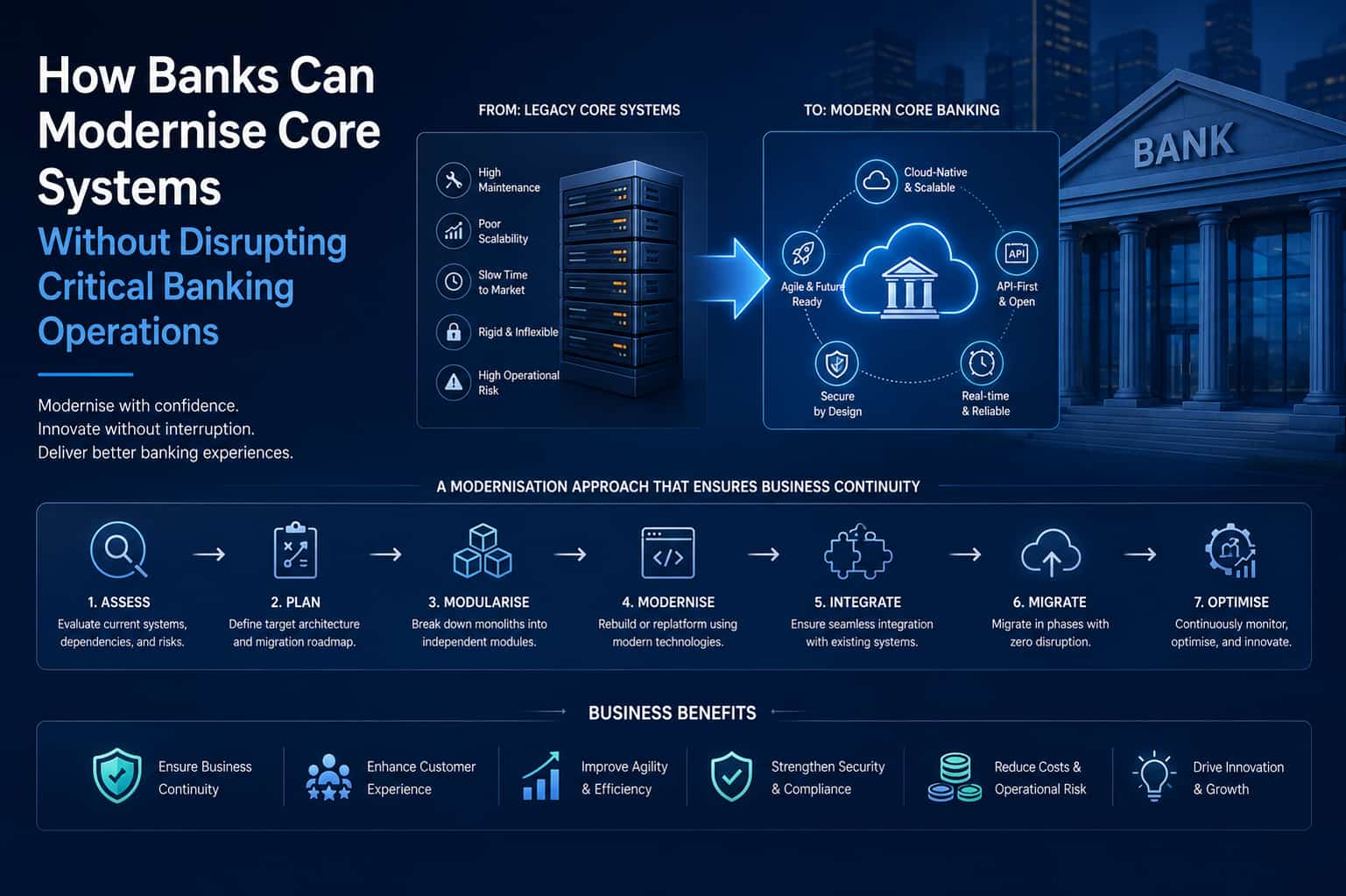
Banking customers expect digital services to be fast, connected, and available across channels. At the same time, many financial institutions continue to depend on legacy banking systems that were designed for a very different technology environment. The challenge is that replacing these systems is rarely straightforward. Core platforms support critical functions such as accounts, transactions, payments, customer data, lending, and regulatory processes. A poorly planned transformation can therefore introduce operational, data, security, and compliance risks.
This is why core banking modernisation increasingly needs to be approached as a phased business transformation rather than a simple technology replacement project. The objective is not merely to install a newer platform. It is to create a modern core banking architecture while protecting the continuity of critical banking operations.
Signs That a Bank's Core Systems Need Modernisation
Legacy banking systems do not necessarily need to be replaced simply because they are old. The stronger indicators are the limitations they create for the business. Common warning signs include:
- Slow product launches because changes require extensive modifications to legacy systems
- Fragmented customer data across multiple applications and databases
- Difficult third-party integrations due to limited APIs or outdated interfaces
- High maintenance complexity caused by aging technologies and specialized dependencies
- Limited scalability when transaction volumes or digital channels increase
- Batch-based processing that prevents timely access to information
- Dependence on outdated technologies that are increasingly difficult to maintain or support
When these issues begin affecting digital initiatives, product development, integration, or operational agility, banks may need to evaluate a broader banking modernisation strategy.
Choosing the Right Core Banking Modernisation Approach
There is no single modernization model that works for every financial institution. The appropriate approach depends on the bank's existing architecture, risk tolerance, business priorities, regulatory environment, and transformation objectives.
1. Full Core Replacement
A full replacement involves migrating from an existing core platform to a modern core banking system.
Advantages:
- Creates an opportunity to redesign the technology foundation
- Can reduce long-term dependence on legacy platforms
- Provides access to modern architecture and capabilities
Challenges:
- High implementation complexity
- Significant data migration requirements
- Greater operational disruption risk
- Requires extensive testing and change management
This approach may be appropriate when the existing platform has reached fundamental architectural limitations and incremental modernization is no longer practical.
2. Incremental Modernisation
Incremental modernization focuses on improving the existing environment in stages. Banks might modernize specific applications, databases, interfaces, or services while continuing to operate the existing core. This can reduce disruption and allow teams to learn from each phase. However, running old and new components together can create additional integration and operational complexity.
3. Strangler-Pattern Modernisation
The strangler pattern gradually replaces individual legacy capabilities with modern services. Instead of replacing the entire core at once, a bank identifies specific functions that can be separated and rebuilt. New services gradually take over responsibilities previously handled by the legacy system. This approach can reduce transformation risk because the organization does not need to change every critical capability simultaneously.
4. API-Led Modernisation
API-led banking creates controlled interfaces between legacy systems and newer applications. APIs can allow digital banking applications, partner platforms, mobile channels, and other services to interact with core capabilities without requiring every system to be directly connected to the underlying legacy platform. This approach can be particularly useful when a bank wants to improve integration while continuing to modernize the core environment over time.
5. Cloud-Enabled Transformation
Cloud banking can provide modern infrastructure capabilities such as elastic resources, automation, managed services, and new approaches to application deployment. However, moving a legacy core to the cloud does not automatically make the architecture modern. Banks still need to evaluate application design, security, data architecture, regulatory requirements, resilience, and operational controls.
Comparing the Modernisation Approaches
Instead of choosing a single modernization approach, banks should evaluate each strategy based on its potential disruption, flexibility, implementation complexity, and business requirements. Full core replacement offers high flexibility and supports major platform transformation, but it generally involves higher disruption risk and greater implementation complexity. Incremental modernization provides a lower-risk path by allowing banks to transform systems gradually, although managing both legacy and modern components can introduce additional complexity.
A strangler-pattern approach also reduces disruption by progressively replacing individual legacy capabilities with modern services, offering high flexibility while requiring careful integration planning. API-led modernization can provide a relatively low-disruption way to connect legacy systems with modern applications and digital channels, making it useful for banks that want to improve integration without immediately replacing their core. Cloud-enabled transformation can provide high flexibility for modernizing infrastructure and applications, although the level of disruption and complexity varies depending on the systems being migrated. In practice, banks may combine several approaches—for example, using APIs to expose legacy capabilities, gradually replacing selected services, and eventually moving suitable workloads to a modern cloud-based environment.
Data Migration and Integration: The Critical Challenge
One of the most difficult parts of core banking transformation is moving and connecting data without compromising operational continuity. Banking environments can contain customer profiles, account information, transaction histories, loan records, payment information, and other interconnected datasets. Migration therefore requires more than transferring database records. Banks need to consider:
- Data quality and duplication
- Customer and account relationships
- Transaction integrity
- Data mapping between old and new systems
- API and application dependencies
- Regulatory and reporting requirements
- Security and access controls
- Data reconciliation
- Legacy interfaces and downstream applications
- Backup and recovery processes
Testing should include functional testing, integration testing, performance testing, security validation, data reconciliation, and business continuity scenarios. A phased migration can also allow banks to validate individual capabilities before expanding the transformation.
How Modern Architecture Supports Digital Banking
A well-designed modernization program can create a stronger foundation for digital banking transformation. Modern architectures can make it easier to support:
Real-Time Banking
Modern services and data architectures can help reduce dependence on batch-oriented processing and enable more timely access to information where appropriate.
Open Banking Integrations
API-based architectures can simplify controlled connections with fintech platforms, partners, and other external services.
Digital Channels
Mobile and web banking applications can interact with modern services through APIs rather than depending on tightly coupled legacy interfaces.
Faster Product Development
When capabilities are modular and accessible through standardized interfaces, development teams can potentially introduce or modify digital services without changing the entire core system.
Automation
Modern platforms can provide better integration with workflow automation, analytics, AI, and other enterprise technologies. The actual business value depends on implementation quality, architecture, governance, and how effectively the new environment supports business priorities.
Core Banking Modernisation Roadmap
Banks can approach modernization through six practical stages:
1. Assess the Existing Environment
Map applications, databases, integrations, infrastructure, dependencies, and critical business processes.
2. Define Business Priorities
Identify which problems modernization needs to solve—such as integration limitations, product development constraints, scalability, or digital channel requirements.
3. Select the Modernisation Strategy
Determine whether full replacement, incremental modernization, strangler-pattern modernization, API-led transformation, cloud adoption, or a combination is appropriate.
4. Build the Target Architecture
Define the desired modern core banking architecture, including APIs, applications, data services, security controls, integration layers, and infrastructure.
5. Modernise in Controlled Phases
Prioritize manageable workloads and capabilities. Use extensive testing, monitoring, rollback procedures, and operational safeguards.
6. Continuously Optimise
Modernization should not end at migration. Banks should continuously review architecture, security, performance, integration, and business requirements.
FAQs
1. What is core banking modernisation?
Core banking modernisation is the process of transforming legacy core banking applications, infrastructure, data, and integrations to create a more flexible and maintainable technology environment.
2. Should banks replace their entire core banking system?
Not always. Full replacement is one option, but incremental modernization, API-led approaches, and strangler-pattern transformation can allow banks to modernize capabilities progressively.
3. How can banks modernize without disrupting operations?
Banks can reduce disruption through phased implementation, controlled migrations, extensive testing, parallel operations where appropriate, strong monitoring, and carefully defined rollback and business continuity procedures.
4. How important are APIs in core banking transformation?
APIs can play an important role by creating controlled connections between core banking capabilities, digital channels, fintech platforms, and other enterprise applications.
5. Does moving core banking to the cloud mean the system is modernized?
No. Cloud adoption is an infrastructure decision, while modernization also involves application architecture, data, integration, security, processes, and operating models.
Building a Future-Ready Banking Technology Foundation
Successful core banking modernisation is ultimately about balancing innovation with operational stability. DashMindsIQ helps banks modernize their technology foundation while continuing to protect the systems that customers and employees depend on every day.
A phased, architecture-led approach can help financial institutions address legacy limitations without treating transformation as a single high-risk technology replacement exercise.
Planning a core banking transformation? Talk to DashMindsIQ about developing a practical banking modernization strategy, modern architecture, API-led integration, cloud transformation, and a phased path beyond legacy banking systems.