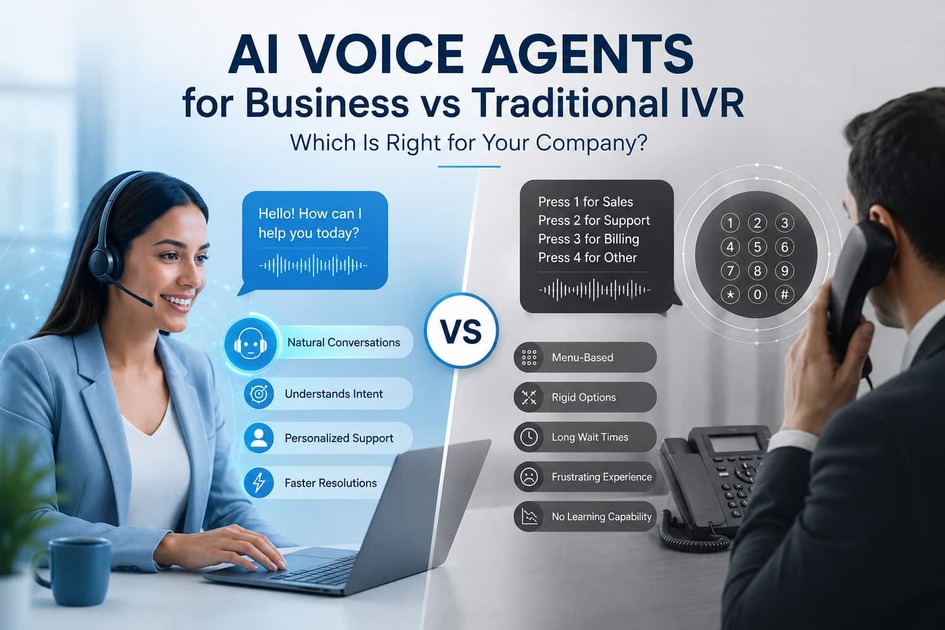
Customer calls remain an important business channel, but the way organizations manage those conversations is changing. Traditional Interactive Voice Response (IVR) systems can route callers through predefined menus, while modern AI voice agents for business can understand spoken requests, maintain conversational context, access business systems, and respond dynamically.
For companies handling large call volumes, the decision is not simply whether to replace IVR with AI. The more important question is: which conversations should be automated, and which should remain with human teams? The answer depends on the complexity of customer interactions, integration requirements, security considerations, and the level of human oversight required.
Where AI Voice Agents for Business Can Create Real Value
AI voice agents are most useful when businesses have repetitive, high-volume conversations that still require some level of understanding and decision-making.
1. Customer Service
Customer service teams often spend significant time answering recurring questions about products, services, account information, delivery updates, or basic troubleshooting. An AI voice agent can handle suitable first-line conversations, identify the customer's intent, retrieve relevant information from connected systems, and provide an answer. When an issue requires human judgment, the conversation can be transferred to an appropriate agent. For example, instead of navigating several IVR menus, a customer could simply say, “I want to know why my payment hasn't gone through.” The voice agent can identify the request and determine the appropriate next step. Businesses should establish clear human escalation rules for complaints, sensitive requests, complex technical issues, or situations requiring discretion.
2. Lead Qualification
Sales teams frequently receive inquiries that require basic qualification before a salesperson becomes involved. An intelligent voice agent can ask predefined qualification questions, understand responses, capture relevant information, and potentially schedule a sales conversation. This can help sales teams focus their time on more qualified opportunities rather than manually processing every initial inquiry. CRM integration is particularly important here. Lead information should be captured accurately and transferred to the organization's existing workflow.
3. Appointment Scheduling
Healthcare providers, service businesses, professional firms, and other appointment-driven organizations can use voice automation for scheduling-related conversations. A voice agent can ask what service the caller requires, check available slots through an integrated system, confirm the appointment, and communicate relevant instructions. The quality of the underlying scheduling integration matters. An AI system should not simply sound conversational; it needs access to accurate, real-time availability.
4. Sales Follow-Ups
Sales teams often struggle to consistently follow up with prospects. AI voice agents for business can support routine follow-up calls, remind prospects about previous interactions, answer basic questions, and determine whether the prospect wants to continue the conversation. However, organizations should carefully define the point at which a human salesperson takes over. High-value negotiations, complex objections, and relationship-driven sales are usually better handled by people.
5. Order and Delivery Status
Order-status calls are another example of a highly repetitive workflow. Instead of asking customers to navigate multiple IVR options, a conversational voice agent can authenticate the caller, retrieve order information, and provide an update. This type of use case can be particularly suitable for automation because the conversation follows relatively predictable business rules and depends on information already stored in order management or ERP systems.
6. Collections and Payment Reminders
Organizations may also explore automated calling for payment reminders and collections. A voice agent can communicate payment reminders, confirm basic account information, answer predefined questions, and direct customers toward appropriate payment channels. Because financial conversations can involve sensitive information, businesses need strong authentication, privacy controls, escalation procedures, and monitoring.
7. Internal Employee Support
Voice AI is not limited to external customer interactions. Employees may use voice agents to obtain information about IT support, HR processes, facilities, internal policies, or other routine requests. For example, an employee could ask, “How do I reset my corporate password?” rather than searching through internal documentation. Integration with internal knowledge bases and enterprise systems becomes important for providing reliable responses.
8. After-Hours Communication
Businesses that cannot maintain large human support teams around the clock can use AI voice agents to provide an initial response outside normal operating hours. The objective does not necessarily have to be resolving every issue. The agent can capture the caller's requirement, provide appropriate information, create a support ticket, or arrange a callback. This can extend service availability while maintaining human involvement for situations that genuinely require it.
AI Voice Agents vs Traditional IVR: What's the Difference?
Traditional IVR works primarily through predefined menus and routing rules. A typical interaction might look like:
“Press 1 for sales. Press 2 for support. Press 3 for billing.”
This approach remains useful for predictable workflows where callers need to reach a specific department quickly. AI voice agents use conversational AI and natural language understanding to interpret what callers are saying. Instead of forcing customers to follow a rigid menu structure, they can describe their requirement naturally.
AI voice agents use conversational AI and natural language understanding to interpret what callers are saying. Instead of forcing customers to follow a rigid menu structure, they can describe their requirement naturally.Traditional IVR systems are generally menu-driven and follow predefined pathways, offering limited natural language understanding and primarily focusing on routing calls. In contrast, AI voice agents provide conversation-driven, dynamic interactions with more natural language capabilities and can handle suitable business tasks.
Traditional IVR can be simpler to implement for basic workflows and offers predictable interactions, while AI voice agents provide greater flexibility but typically require more integration, security, and governance. This does not mean traditional IVR is obsolete; it can still be effective for straightforward, predictable call-routing and self-service use cases.
For straightforward call routing, simple authentication, or highly predictable processes, IVR can remain practical and cost-effective. Voice AI solutions become more compelling when callers need to explain their needs in their own words or when the business wants to automate more than basic routing.
How to Decide Whether a Voice Workflow Should Be Automated
Not every phone interaction is a good candidate for automation. Businesses should evaluate several factors before implementing AI-powered customer support or automated calling.
Conversation Complexity
Start with workflows that have predictable objectives and clear business rules. Highly ambiguous or emotionally sensitive conversations may require human involvement.
Human Escalation
Define when the AI should stop and transfer the conversation. A good automation strategy should include human oversight rather than attempting to eliminate human involvement completely.
CRM and ERP Integration
The agent becomes considerably more useful when it can securely interact with systems such as CRM, ERP, scheduling, ticketing, or order-management platforms.
Data Privacy and Authentication
Voice interactions can involve personal, financial, healthcare, or other sensitive information. Organizations need appropriate authentication, access controls, encryption, data handling policies, and monitoring.
Multilingual Requirements
For organizations serving diverse customer groups, multilingual conversational voice technology can be valuable. However, businesses should validate language accuracy, accents, terminology, and regional variations before deployment.
Call Quality and Monitoring
A technically sophisticated voice agent still needs reliable speech recognition, low latency, clear audio, and effective monitoring. Organizations should continuously review conversations and identify failure patterns.
Choosing the Right Approach
The choice between IVR and AI voice agents for business should be based on the workflow—not on technology trends. Traditional IVR can be the right solution when interactions are simple, predictable, and primarily focused on routing. AI voice agents are better suited to workflows where customers need to communicate naturally, where repetitive tasks can be automated, and where integration with business systems can enable meaningful actions.
In many organizations, the strongest approach may actually be a combination of both. Traditional routing can manage simple pathways, while an AI voice layer handles conversational requests and transfers complex cases to human teams. The objective should be to create a better customer and employee experience while improving operational efficiency—not to automate conversations simply because automation is possible.
FAQs
1. What are AI voice agents for business?
AI voice agents are software-based conversational systems that can interact with callers using natural language, understand requests, provide responses, and perform predefined tasks through integrations with business systems.
2. Are AI voice agents better than traditional IVR?
It depends on the use case. AI voice agents offer greater conversational flexibility, while traditional IVR can be effective for simple routing and highly predictable interactions.
3. Can AI voice agents integrate with CRM systems?
Yes. AI voice solutions can be integrated with CRM, ERP, scheduling, ticketing, and other enterprise systems, depending on the available APIs and technical architecture.
4. Should businesses completely replace human customer service agents?
Not necessarily. A strong AI strategy combines automation with human escalation. AI can handle suitable repetitive interactions while people manage complex, sensitive, or high-value conversations.
5. How should a business start implementing voice AI?
Start with a clearly defined, high-volume workflow, establish success criteria, integrate the necessary systems, define escalation rules, test the experience, and continuously monitor performance before expanding to additional use cases.
Build a Smarter Voice Automation Strategy
The opportunity with AI voice agents for business is not simply replacing phone menus. It is about identifying the conversations where intelligent automation can create measurable operational value while preserving human involvement where it matters.
If your organization is evaluating conversational AI, voice automation, or intelligent voice agents, DashMindsIQ can help assess suitable use cases, integration requirements, and a practical path toward enterprise AI adoption.
Talk to DashMindsIQ to explore AI voice agent solutions tailored to your business workflows.